
Press & blogger kitHack The SEO
It tells you which AI crawlers read your pages. Not whether they will quote you: who came, on which page, at what time.
What a site sees when it looks server-side
hacktheseo.com · 90 days- 19,426AI crawler hits
- 8Distinct crawlers identified
- 62%Of all crawl traffic
- 18Agents tracked by name
Read these numbers for what they are. They come from hacktheseo.com over 90 days: one site, and a site that writes about SEO, a topic AI crawlers over-visit. They do not hold for "WordPress sites" in general. What they show is that this kind of measurement is possible, and that nobody publishes it. The real question is what the number looks like on your own site.
Check us in ten seconds
Don't take our word for itRun the command
From any terminal, against your own site, with the plugin active. It impersonates OpenAI's crawler.
Refresh the screen
Open the AI visibility screen in the WordPress admin and reload the page.
The row is there
With the page visited and the timestamp. This is not a demo: it is the entire mechanism.
curl -A GPTBot https://your-site.tld/some-page/Detection reads the User-Agent header on template_redirect, server-side, before any script runs. If it does not work on your install, tell us: that is a bug, not an argument.
A free WordPress SEO plugin that measures AI crawlers
Hack The SEO is a WordPress SEO plugin, published on the official wordpress.org directory on 31 August 2026 under the GPLv2+ licence. It covers the usual technical SEO layer (JSON-LD schema, XML sitemap, redirects, canonical URLs, metadata) and adds something the established plugins do not offer: a server-side record of which artificial intelligence crawlers read your pages.
Why your analytics tool sees nothing
GPTBot, ClaudeBot, PerplexityBot and their peers do not execute JavaScript. An analytics tool built on a JavaScript tag therefore cannot record them. This is not a product gap, it is a technical impossibility. The crawler requests the page, the server answers, and the measurement script never runs. The visit appears nowhere.
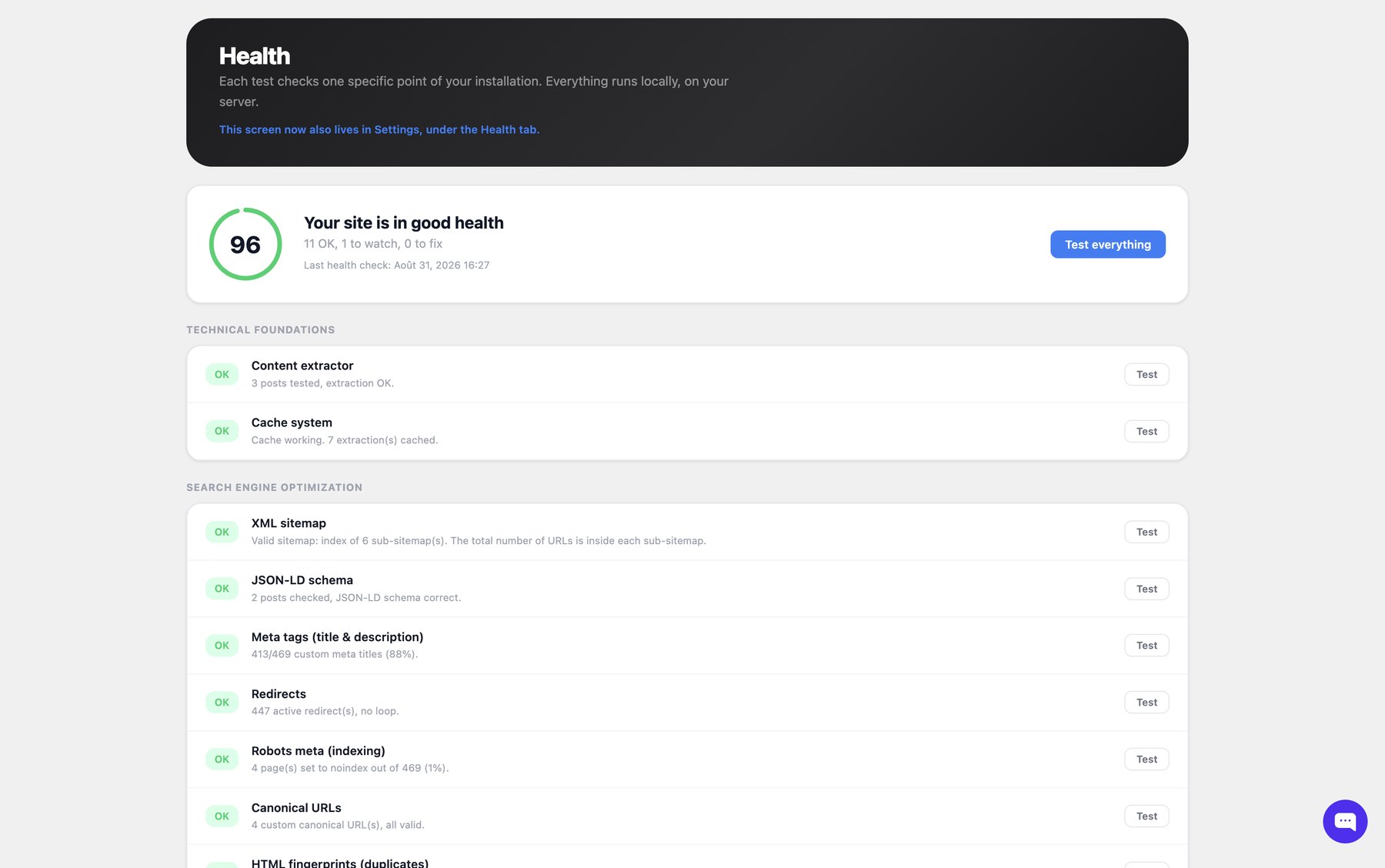
Hack The SEO reads the request at the server level, on WordPress's template_redirect hook, and writes every hit into a table in your own database. Eighteen agents are tracked by name, across OpenAI, Anthropic, Perplexity, Apple, Google, Meta, Cohere and Common Crawl. For each one you get the page visited, the date and the time. Nothing leaves the site: no account to create, no API key, no third-party service in the loop.
What the free version does, precisely
- AI crawler log: 18 agents tracked, server-side logging, history browsable by page and by crawler.
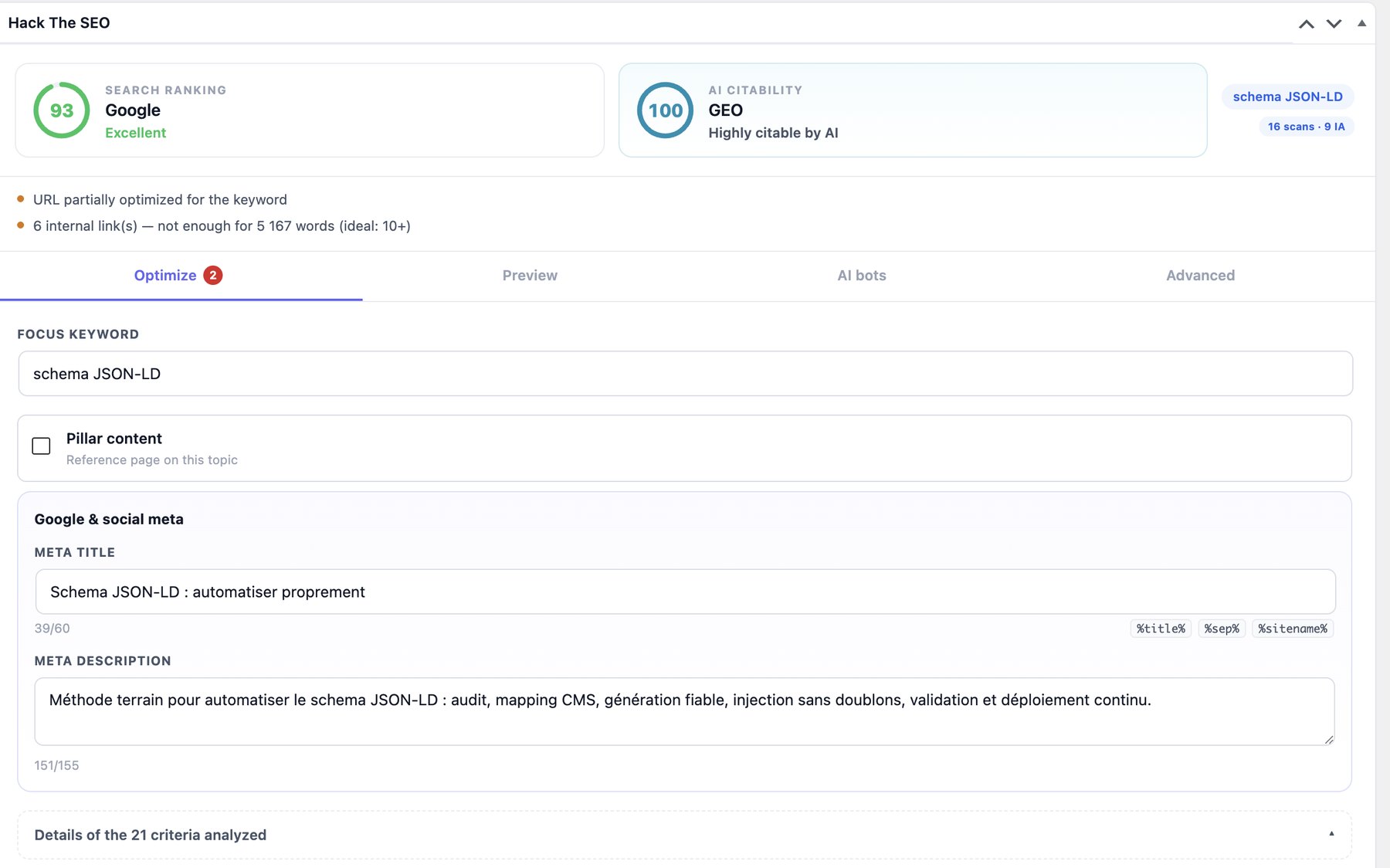
- GEO score per page, out of 100, against six criteria written out in the public readme, shown in the editor next to the classic search ranking score.
- Keyword cannibalization: detection of pages on the site competing for the same query, computed locally.
- An llms.txt file and a Markdown version of every page, served at the page URL followed by .md.
- JSON-LD schema: over 60 types supported, including automatic detection of the AggregateRating produced by around fifteen review plugins.
- 21 on-page checks in the editor, XML sitemap, redirect manager with CSV import and export, canonicals and robots tags.
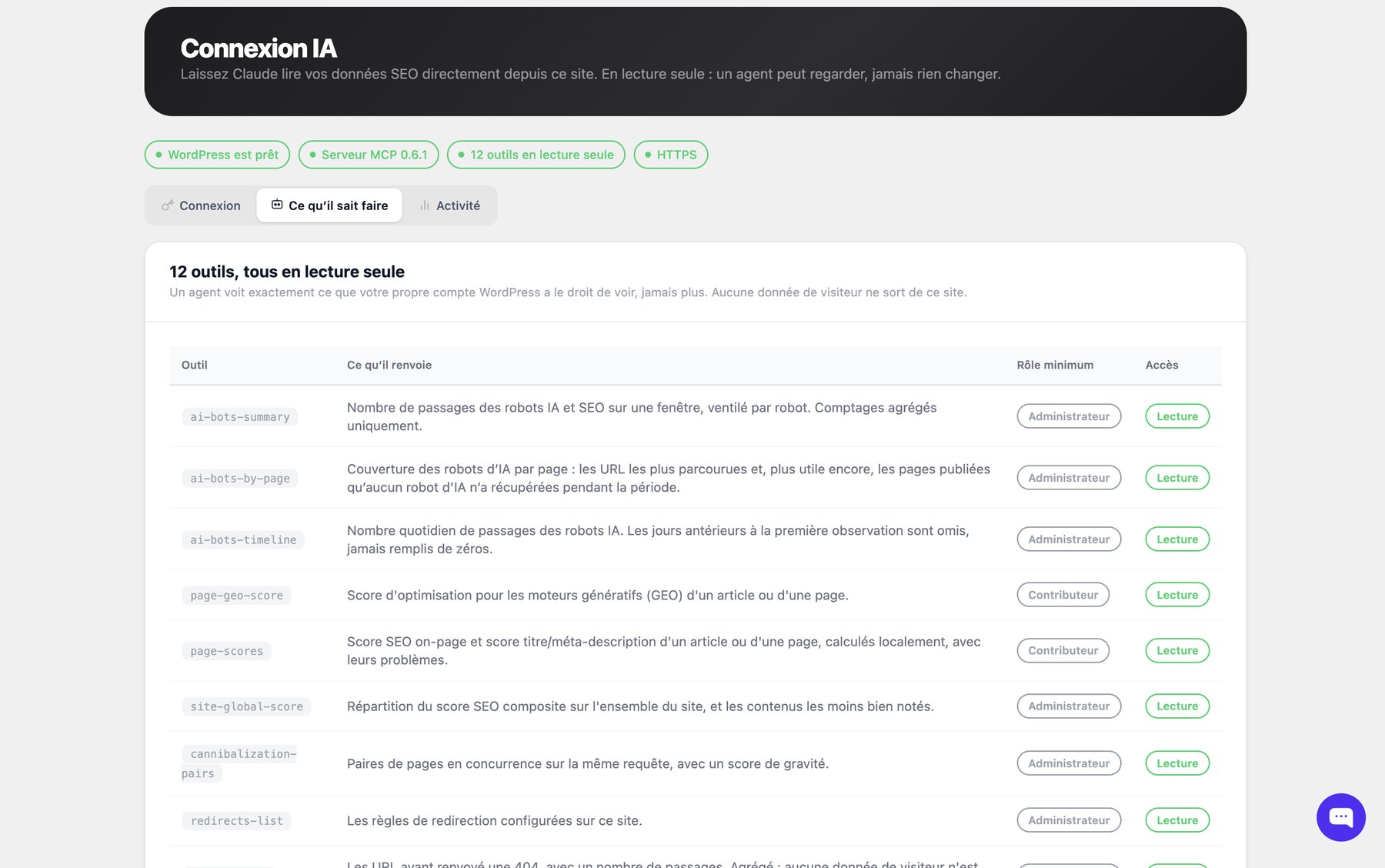
- A read-only MCP server, added in version 1.1.0, which lets you connect an AI assistant such as Claude to the site's SEO data.
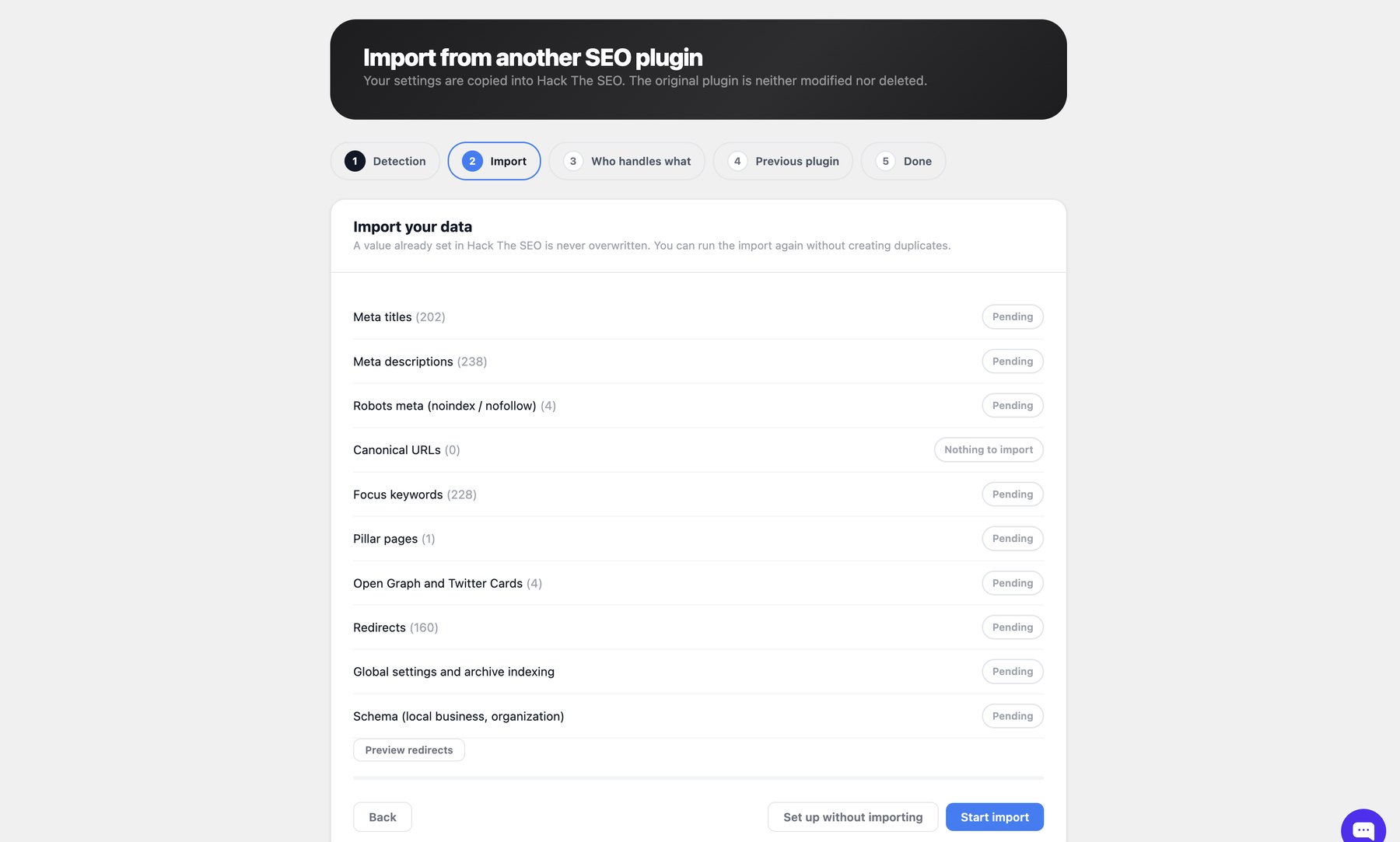
- Import from Yoast, Rank Math, AIOSEO and SEOPress, with a dry run first and the original data left untouched.
What the GEO score actually measures
The GEO score rates a page out of 100 on how quotable it is by a language model, against six criteria: whether the page answers a question explicitly, whether it carries figures and dates a model can lift, whether its headings are phrased as questions, whether its structured data matches its visible content, whether it is reachable without JavaScript, and whether an authoring source is identifiable. The six questions are written out in the public readme and the rules live in PHP in the plugin file, so the score can be argued with rather than believed. It sits next to the classic ranking score in the editor because the two audiences, a search engine and a language model, do not reward the same page.
It is built to live alongside Yoast, Rank Math, AIOSEO and SEOPress
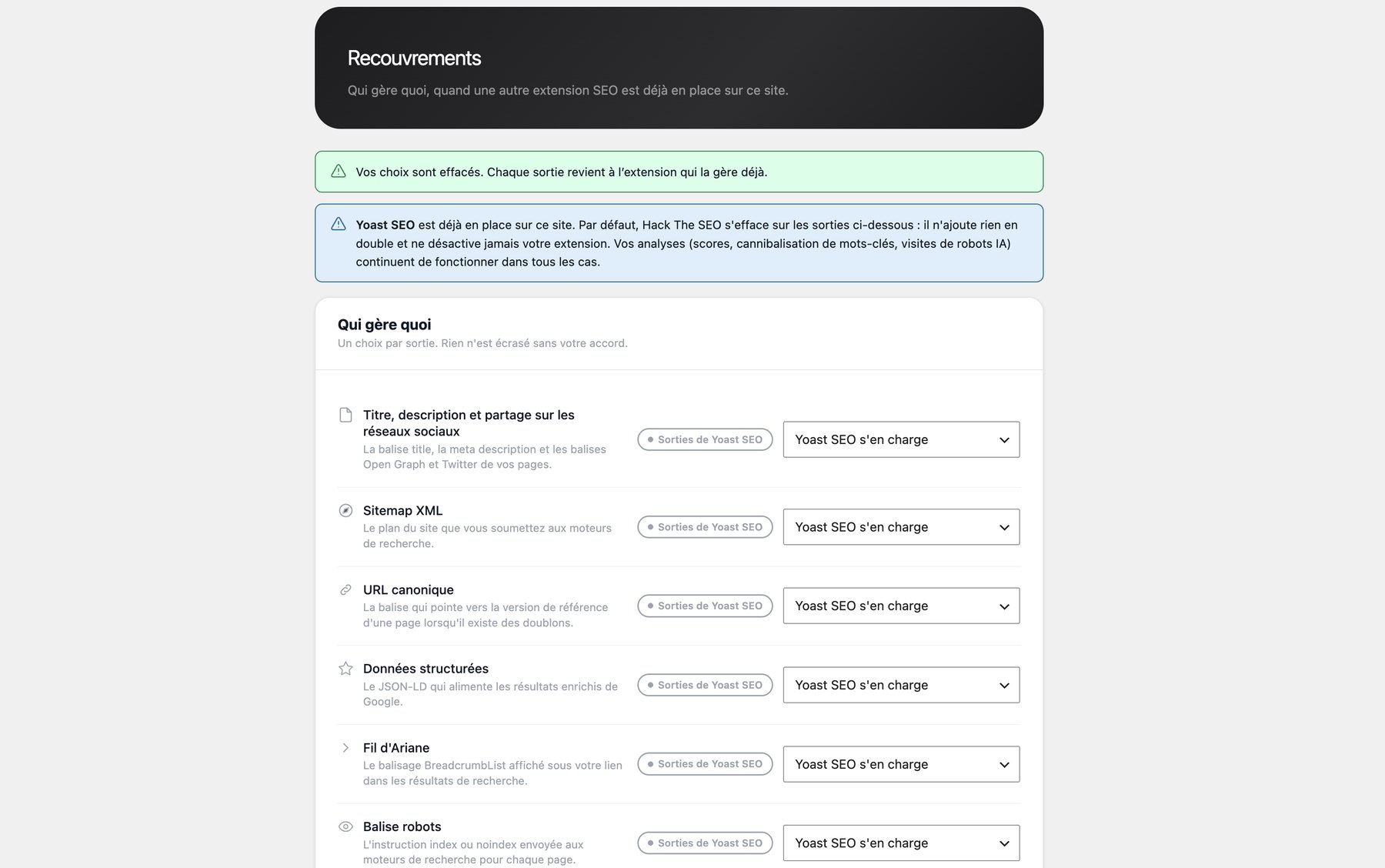
The reason nobody installs two SEO plugins on the same site is duplicate output: two title tags, two canonicals, two JSON-LD blocks, and a site sending contradictory signals. On activation, Hack The SEO detects Yoast SEO, Rank Math, All in One SEO or SEOPress, and stops emitting, module by module, everything the other plugin already handles. It never deactivates it, never changes its settings, and lets you take any module back by hand.
This is what integrators and agencies test first, because it is their first objection. It checks out in a minute on a staging site: the "Overlaps" screen lists every SEO output and says, row by row, which plugin owns it.
An MCP server, and read-only at that
Version 1.1.0 ships an MCP server exposed at /wp-json/htsfree/v1/mcp. Twelve capabilities are published, and all twelve read: none writes, and no setting turns one into a write. Every call is made on behalf of a logged-in WordPress user and checks a capability before answering. The connection is inbound: your AI client calls your site, no data travels to a third-party server.
The counter-argument is better given here than discovered elsewhere: ThinkRank, a plugin released before ours, also ships an MCP server, and theirs writes. Our difference is not the MCP, it is the AI crawler log and the llms.txt.
Requirements, licence, and what it does not send
WordPress 5.9 and PHP 7.4 are enough, tested up to WordPress 7.1. That floor is deliberately low: an agency running thirty client sites does not have thirty up-to-date sites. On the network side, the plugin contacts no third-party service by default. One exception exists, IndexNow, disabled on install: as long as the option is zero, no hook is even registered. A single file is written to disk, the sitemap cache, and no redirect is ever written into .htaccess.
What we do not promise
No ranking, in Google or in an AI answer. Dropping an llms.txt file does not make a site "visible in ChatGPT": that claim has no public evidence behind it, and the plugin's readme says so explicitly. We measure crawler hits. We do not sell an outcome.
The rest of this page holds everything you need to write without asking us for anything: editorial angles that stand on their own, ready-to-paste copy, royalty-free screenshots, the comparison against competing plugins, and the list of things we refuse to do.
Six angles, not a feature list
To write withEach one stands on its own and checks out without taking our word for it. Pick one, not six.
- SEO media · data blogs "Your analytics cannot see AI crawlers, and that is structural" The strongest angle, because the reader verifies it in ten seconds on their own site. What not to conclude from it: that the site will be quoted by ChatGPT. We measure hits, we do not sell an outcome.
- Integrators · agencies "A second SEO plugin, without breaking the first" On activation the plugin detects Yoast, Rank Math, AIOSEO or SEOPress and stops emitting, module by module, whatever the other one handles. It never deactivates it and never touches its settings. Unusual, testable in a minute, and it is every integrator's first objection.
- Client site portfolios "The SEO plugin that still runs on PHP 7.4" WordPress 5.9 and PHP 7.4 are enough. An agency running thirty client sites does not have thirty up-to-date sites. Competing requirements move with every release: check them on the day you write, on their own directory pages.
- Developers · AI media "Connect Claude to your WordPress, read-only" 1.1.0 ships an MCP server. Twelve capabilities, and all twelve read. Every call is made by a logged-in WordPress user and checks a capability. The connection is inbound. The counter-argument, worth giving yourself: ThinkRank has an MCP too, and theirs writes.
- Opinion pieces "What this plugin refuses to promise" The public readme states in plain words that no llms.txt makes a site "visible in ChatGPT", that the claim has no evidence behind it, and that no ranking is promised. In a market saturated with unverifiable promises, that is the one angle competitors cannot copy without contradicting themselves.
- Data stories "62% of one site's crawl already comes from AI" The figure is real but it holds for one site, ours, over 90 days, on a topic AI crawlers over-visit. It does not generalise, and that is precisely the story: nobody publishes this measurement, although any site can run it at home.
Ready-to-publish descriptions
Copy and pasteUse them as they are or rewrite them. You are under no obligation to use our wording, and there is nothing to clear with us.
Screenshots
Royalty-free · direct downloadTaken on a real site, not on an empty install. Crop them however you like, no permission needed. For high-resolution originals or other screens, write to us.
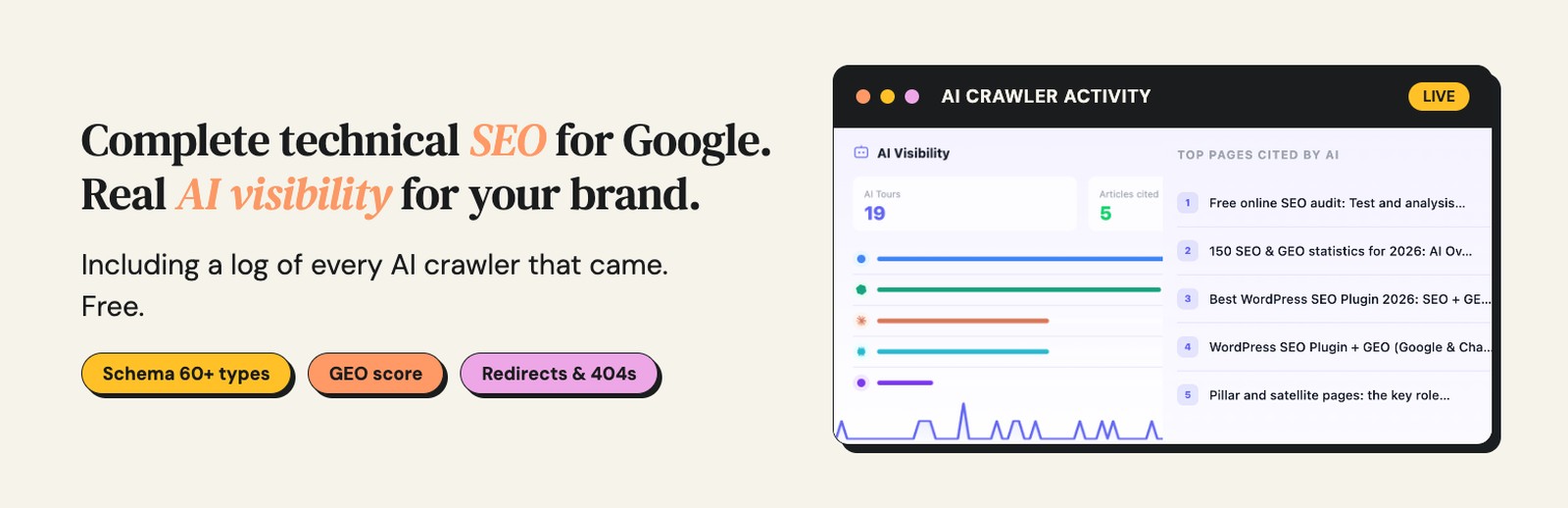
Download all six screenshots (ZIP)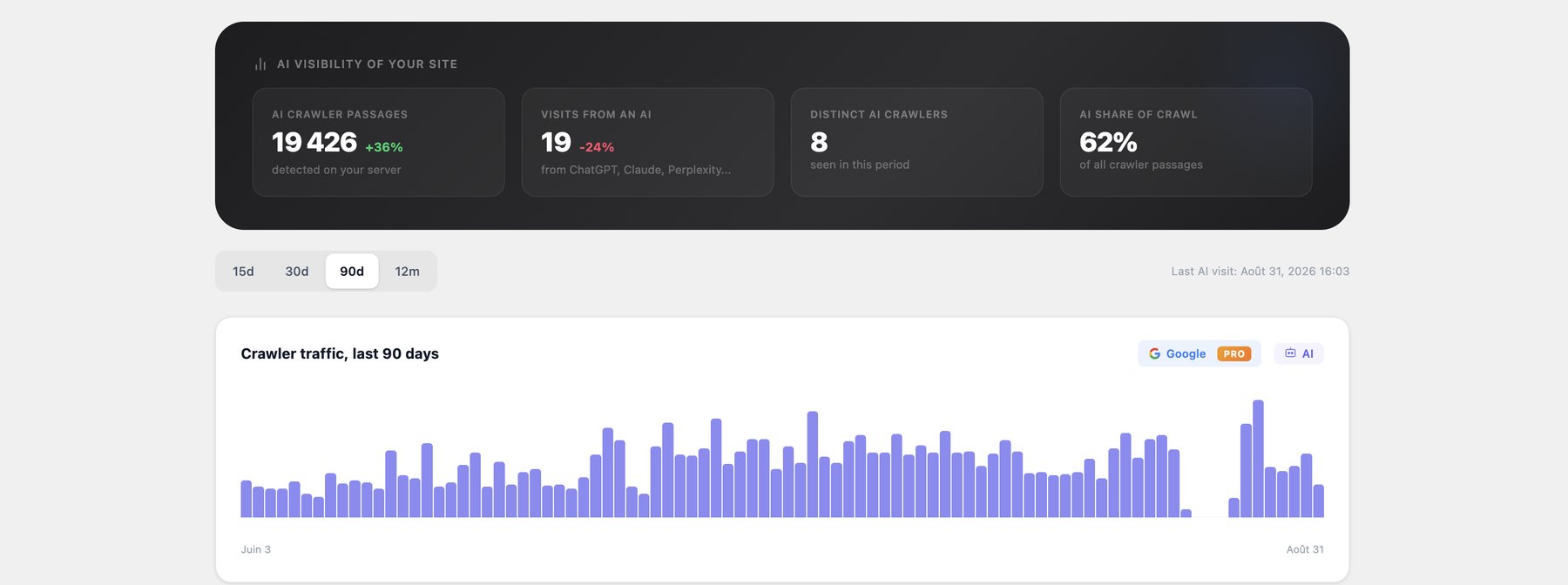
The figures, and what backs each one
Verifiable| What we claim | What backs it |
|---|---|
| 18 AI crawlers tracked | named list in the public readme and in the plugin screen |
| 12 MCP capabilities, all read-only | "AI connection" screen, "what it can do" tab |
| 60+ JSON-LD schema types | readme, Structured data screen |
| 21 on-page checks | editor panel, expanded detail |
| 6 criteria for the GEO score, out of 100 | the six questions are written in the readme, the rules are in PHP in the file |
| Zero outbound calls by default | grep wp_remote_ gives 9 call sites: 2 for IndexNow, 7 that load a page of your own site |
| One file written to disk | the sitemap cache. No redirect is ever written into .htaccess |
| WordPress 5.9 · PHP 7.4 | readme header on wordpress.org |
One phrasing not to shorten. We do not write "zero external calls" flat, but "no call to a third party, with one exception, IndexNow, disabled by default". The option is 0 on install, and while it is 0 no hook is even registered. Shortening the sentence hands an attentive reader proof that we exaggerate.
The comparison, ThinkRank included
No dodgingThe four established plugins cover classic SEO better and have done so for longer: replacing them is not the point. ThinkRank sits on the same positioning as us, MCP included, so leaving it out would be dishonest, and you would find it anyway.
| Hack The SEO free | Yoast · Rank Math AIOSEO · SEOPress | ThinkRank | |
|---|---|---|---|
| Server-side AI crawler log | yes · 18 agents | no | not announced |
| GEO score per page | yes · 6 criteria | no | not announced |
| Keyword cannibalization | yes · computed locally | on paid tiers | not announced |
| llms.txt and Markdown pages | yes | no | not announced |
| Coexistence without duplicate output | yes · by default | not designed for it | to be checked |
| MCP server in the plugin | yes · read-only | no | yes, and it writes |
| Requirements | WP 5.9 · PHP 7.4 | higher, to be checked | to be checked |
| Active installs | < 10 · since 31/08/2026 | 1M to 5M+ | 10,000+ |
Yes, fewer than ten installs. The plugin has been published since 31 August 2026. Hiding that would not survive thirty seconds, the directory listing shows it. A blogger testing a brand new plugin already knows, and it is often what makes it interesting.
The paid version
A separate product, not a tierThe free plugin measures and fixes case by case. The paid one decides and executes in bulk.
That is the dividing line, and it also explains why it is there: what is given away is the diagnosis, what is sold is the work the diagnosis triggers.
These are not two tiers of one product but two different plugins. You do not "upgrade" the free one: you install the other, and the free one steps aside on its own. The free plugin is not a trial and never expires.
Public pricing: Pro 99 €/month, Ultra 249 €/month. A separate SaaS platform also exists: do not mix it up with the plugin, they are two products.
- ProSemantic cocoon and clusteringGroups content by semantic proximity computed from embeddings, and builds the tree. It is the most distinctive piece of the paid plugin, and the one with no free equivalent anywhere.
- UltraAutomated internal linkingPicks the links and pushes them into WordPress, instead of merely flagging orphan pages.
- ProAI redirect suggestionsAnalyses 404s and proposes the best-matching page with a confidence score, approvable in batches.
- UltraBulk cannibalization actionsRedirect or canonicalise a whole cluster in one click, reversibly.
- ProArticle generation and SEO coachUnlimited coach, 10 articles a month on Pro, 30 with images on Ultra.
- ProGoogle Search ConsoleReal clicks, impressions and positions in place of sample figures.
- UltraInbox and autonomous agent modePlus the e-commerce agent for WooCommerce catalogues.
- PaidWrite-capable MCPWhere the free plugin stops at twelve reads.
The questions we get
Short answers- Will it conflict with Yoast on my client sites?
- No. The plugin steps aside on every module Yoast, Rank Math, AIOSEO or SEOPress already handles. That is the default behaviour, not a checkbox, and it never deactivates the other plugin. On an isolated staging site it checks out in thirty seconds through the "Overlaps" screen.
- What does the plugin send back to you?
- Nothing. The crawler log is written server-side, in the site's own database. No account, no API key, no external service. The only possible outbound connection is IndexNow, disabled on install: while the option is zero, no hook is registered.
- Is it really free, or is it a trial?
- Free, under GPLv2+, with no account and no time limit. The paid version is a different plugin, not an unlock of this one: the free plugin does not expire and does not degrade.
- Why have I never heard of you?
- Because the plugin has been published since 31 August 2026 and has fewer than ten active installs. The directory listing shows it, so we may as well say it ourselves. A blogger testing a brand new plugin already knows, and it is often what makes it interesting.
- Does an llms.txt make a site visible in ChatGPT?
- No, and nobody knows how to demonstrate it. We will not write that, and the plugin's public readme says so explicitly. What the plugin measures is crawler hits: who came, on which page, at what time.
- Can I reuse your screenshots and your name without permission?
- Yes, to write about the plugin: screenshots, name and banner may be reproduced and cropped without asking us for anything. The exact name is "Hack The SEO – AI Bot Tracker, GEO Score, JSON-LD Schema & Cannibalization"; in running text, Hack The SEO is enough.
- How do I check your figures without trusting you?
- The 18 agents and the 6 GEO score criteria are listed by name in the public readme on wordpress.org. The crawler log is testable with a single curl command (see above). The 62% figure is from our own site over 90 days and does not generalise: always give it with its scope.
- Which PHP and WordPress versions does it run on?
- WordPress 5.9 minimum, PHP 7.4 minimum, tested up to WordPress 7.1. That floor is deliberately low: client site portfolios are never all up to date.
What we will not do
Our rules, not yours- We do not pay for coverageNo sponsored post, no paid link insertion, no promo code in exchange for a mention. If someone offers you that in our name, it is not us.
- We do not ask for reviews in exchange for anythingGuideline 9 on wordpress.org forbids it, and enforcement is brutal: a plugin has already been pulled from the directory for offering a discount in exchange for a review, with two years of reviews deleted.
- We do not review your articleTest it, and mention it only if it holds up. A negative test published is worth more to us than a friendly write-up: it tells us what to fix.
- We promise no rankingNot in Google, not in an AI answer. Dropping an llms.txt does not make a site visible in ChatGPT: that claim has no evidence behind it.
Test it, and mention it only if it holds up
Install it from the official directory in a minute. If anything does not work the way this page describes, write to us: that is a bug, and we would rather know before you do.
Practical details
Quote as-isExact name
Hack The SEO – AI Bot Tracker, GEO Score, JSON-LD Schema & Cannibalization
In running text: Hack The SEO.
Who publishes it
Eric Ibanez and Bruno Ibanez, France. Co-authors of an SEO book published by Dunod.
Figures recorded on 8 September 2026, plugin at version 1.1.0. Screenshots and counters are dated: if you are writing several weeks later, check the directory listing, it is authoritative. The screenshots and the banner on this page may be reproduced to write about the plugin, with no permission to ask for.