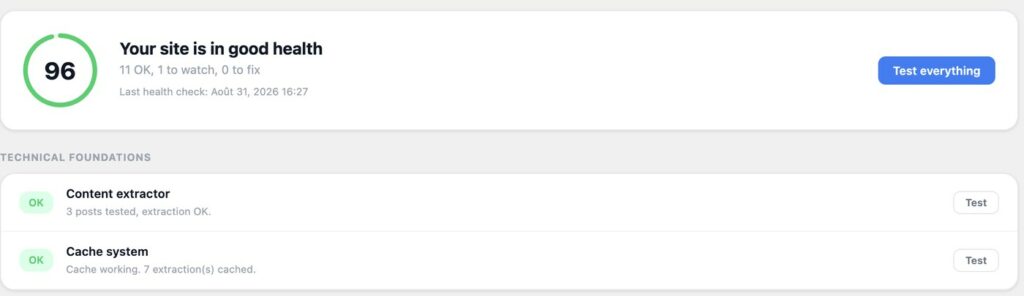
TL;DR: a WordPress SEO audit with Claude takes 4 steps. You connect Claude to your site through MCP, it runs 12 checks (9 for SEO, 3 for GEO), ranks the problems by lost clicks, then fixes only what you approve. Plan on 30 minutes, with no spreadsheet and no code.
What is a WordPress SEO audit with Claude?
It is a check of your site run by Claude, which reads the real data inside WordPress instead of giving you generic advice. It looks at what holds your site back in Google (pages that are not indexed, broken links, pages nobody links to, content that competes with itself) and at what stops an AI from citing you (an unclear answer, no author, no source).
The goal is not a score out of 100. The goal is a ranked list of fixes, each with the page it concerns, so you know what to do next.
What does Claude need to audit your site?
It needs access to your site data. That access goes through the Model Context Protocol (MCP), a standard plug: your site exposes tools and Claude calls them. With the Hack The SEO plugin, Claude can read indexing, redirects, the sitemap, schema markup, internal links, Search Console and AI crawler visits.
The plugin’s MCP server is read-only by default and every call is logged. Nothing changes on your site without your yes.
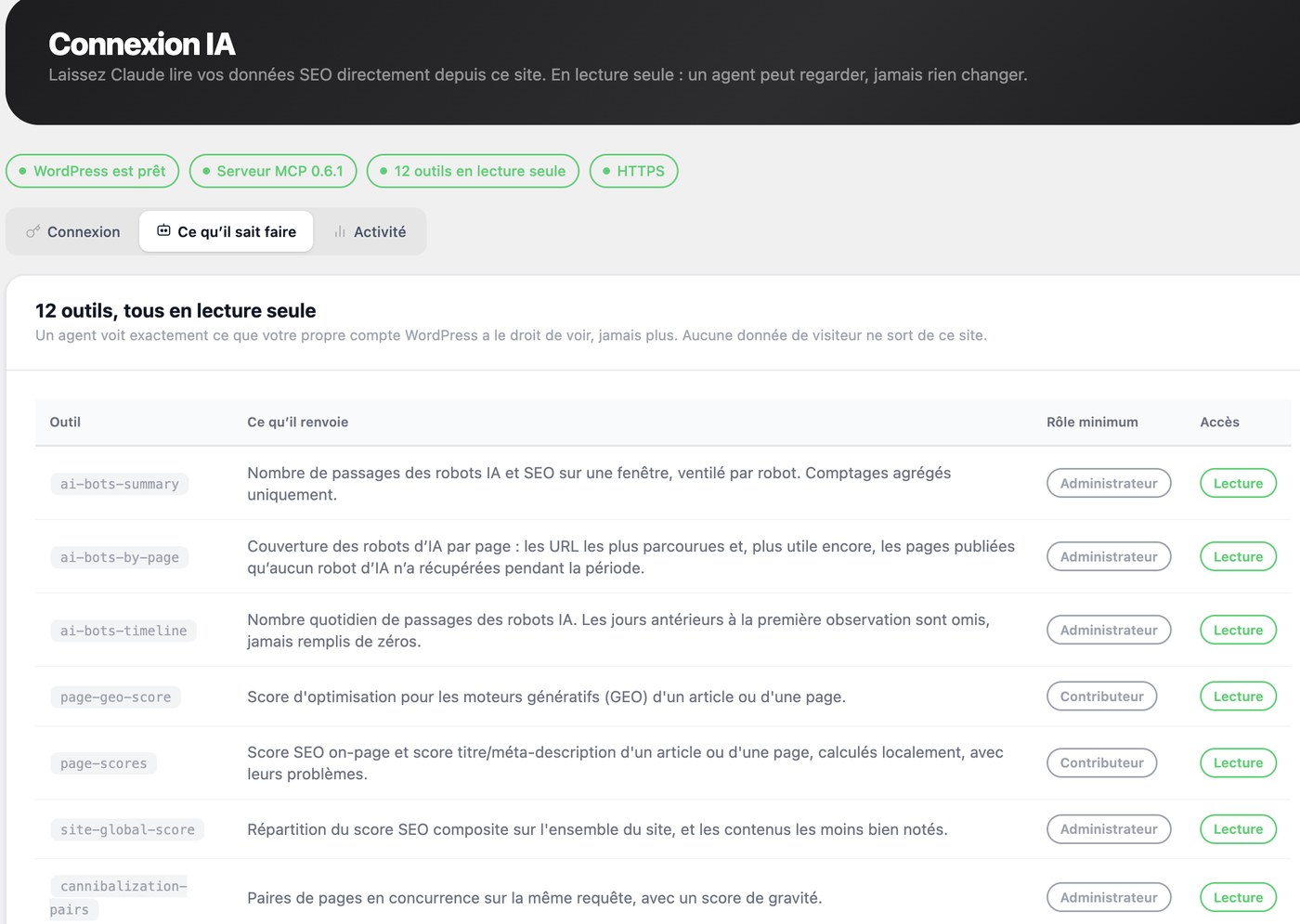
So you need three things: a WordPress site, the plugin connected to Claude, and Search Console linked so the audit starts from your real numbers.
Which checks does a complete SEO and GEO audit include?
A useful audit does not stop at a handful of checks. Here are the 12 checks the plugin gives Claude, with the tool that reads each one. Checks 1 to 9 cover SEO (ranking well in Google). Checks 10 to 12 cover GEO (being cited in AI answers).
| # | Check | What Claude verifies | Plugin tool |
|---|---|---|---|
| 1 | Indexing | served noindex, canonical, robots.txt, presence in the sitemap | hts_get_indexability |
| 2 | Page defects | title, description, main heading, images without alt text, orphan pages | hts_get_page_defects, hts_list_worst_articles |
| 3 | Structured data | duplicates, FAQ conflicts, stray markup | hts_audit_all_schemas |
| 4 | Redirects | active rules, recurring 404s, chains | hts_audit_redirects |
| 5 | Sitemap | served or not, last submission to Google, Bing and IndexNow | hts_get_sitemap_status |
| 6 | Internal links | orphan pages inside a cluster, broken internal links | hts_audit_cocon, hts_verify_anchors |
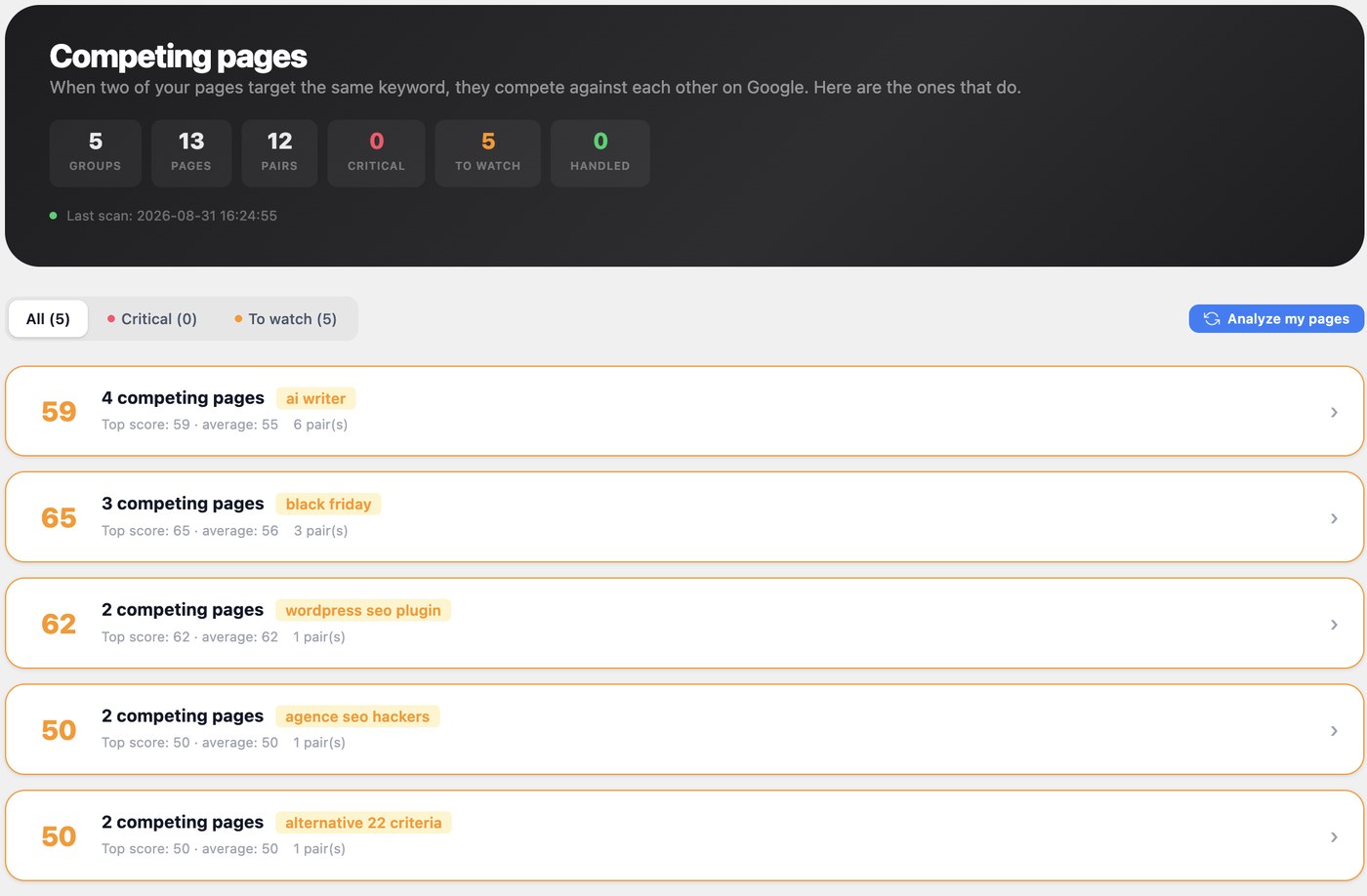
| 7 | Cannibalization | pages competing for the same queries | hts_get_cannibalization |
| 8 | Freshness | content with no real update for more than 180 days | hts_get_stale_articles |
| 9 | Missing clicks | queries where you are visible but rarely clicked, ranked by possible gain | hts_get_missing_clicks |
| 10 | AI-citable answer | direct answer, FAQ, figures, sources, passages suited to voice | hts_get_geo_score, hts_get_speakable_audit |
| 11 | Author | Author schema, bio, publication date | hts_get_author_schema_audit |
| 12 | AI crawlers and llms.txt | AI bots blocked or not, visits, llms.txt file | hts_get_indexability, hts_get_ai_bot_visits, hts_get_llmstxt |
A word of caution on the last check: llms.txt is housekeeping, not a proven lever. It does not make a site visible in ChatGPT. Claude checks it so everything is clean, not to promise you citations.
How do you run the audit, step by step?
Step 1. Connect Claude to your site
Turn on the plugin’s MCP server, then add its address as a connector in Claude. To check it works, ask Claude to test the connection: it should answer with your site address and the plugin version.
Step 2. Ask for the SEO audit
Paste a clear instruction that says read-only:
Run the SEO audit of my WordPress site in read-only mode. Run the 9 SEO checks, rank the problems by lost clicks and give the page concerned for each one. Do not change anything.
Claude calls the tools one by one and hands you a table. Errors on pages already visible in Google come up top, because those are the ones that cost you clicks.
Step 3. Ask for the GEO part
GEO measures how easily an AI can cite you. Ask for example: “Run the GEO audit of my 5 most visible pages: direct answer, FAQ, figures, sources, author.” Claude reads the GEO score of each page and tells you what is missing, such as “no external source” or “intro without the query in the first words”.
Step 4. Sort, then approve
Keep 3 fixes at a time. For each one, Claude shows you the before and the after, and you answer yes or no. To see what the tool does without going through Claude, the WordPress SEO audit page walks through it.
What does this audit show on hacktheseo.com?
We ran it on our own site on October 9, 2026, then re-read part of the checks on October 12. Here is what Claude read.
| Check | Result on hacktheseo.com |
|---|---|
| Structured data | 10 pages audited, 0 errors, 0 duplicates (Oct 9) |
| Redirects | 451 active rules, 93 chains inferred from the rules (to confirm with a test), 1 rule that leads to a 404 page (Oct 9) |
| Recurring 404s | 20 addresses, most with a suggested target (Oct 9) |
| Sitemap | served, 392 addresses, 58 IndexNow submissions without failure (Oct 9) |
| Indexing | 6 pages served with noindex, no AI bot blocked on the homepage (Oct 12) |
| Internal links | 15 clusters, including an “Uncategorized” one with 37 pages (Oct 9) |
| Cannibalization | 21 groups at the last scan, which dates from July 16: to rerun |
| Freshness | 129 pieces of content with no real update for more than 180 days (Oct 9) |
| AI crawlers | 8,767 visits in 28 days (Aug 30 to Sep 26) against 3,939 for Google, Bing and other search engines |
What we take from it: an audit finds leads fast, but the order matters more than the list. On our site, the missing-clicks ranking puts the French query “onpage seo audit” on top: 905 impressions in 28 days at position 24.4, for no click. The tool estimates 164 clicks that a top 3 spot would have taken. That is an estimate based on the average top 3 click rate, not a promise of ranking.
Second finding: the last cannibalization scan was almost three months old. Claude says so instead of hiding it. An honest audit flags the age of its own data.
How do you fix things without breaking anything?
The rule is simple: the audit reads, the fix asks for your approval. Three safeguards apply to every action:
- a before and after preview ahead of any write;
- your yes for each action;
- a rollback available for 30 days, with a full log.
We add one more rule of our own: we never delete or redirect a page that has impressions over the last 90 days. We improve it and link to it.
What are the limits of an audit run with Claude?
Claude does not replace your judgment. It does not see your market and it can be wrong about a page. Search Console data lags by 2 to 3 days. And an audit measures the state of the site: it promises no position in Google and no citation by an AI. Traffic is measured afterwards in Search Console.
FAQ
Can you run your own SEO audit?
Yes. With a tool connected to your site, the 12 checks fit in a single conversation. Without access to the data, you have to export each list by hand, which takes far more time.
How much does a WordPress SEO audit cost?
A consultant charges according to the size of the site. With Claude and the Hack The SEO plugin, it is the subscription: €249 per month excluding VAT, with no commitment, after a 20-minute demo.
Can ChatGPT run an SEO audit?
Yes, if it can call tools on your site. Without access to the data, an AI assistant can only give general advice.
Is there a free SEO audit?
Yes, several online tools offer a basic version. It gives you a first list, not a fix plan ranked by impact.
What is the difference between an SEO audit and a GEO audit?
SEO aims at ranking well in Google. GEO aims at being cited in AI answers. The two overlap (structure, FAQ, freshness) but they are not measured the same way.
Do you need to code to audit your site with Claude?
No. You write your requests in plain English, Claude calls the tools and you approve the previews.
Sources
- SEO Starter Guide, Google Search Central
- Model Context Protocol, official documentation
- Search Console Help
Read next
Want to see the audit run on your own site? Book a free 20-minute demo.