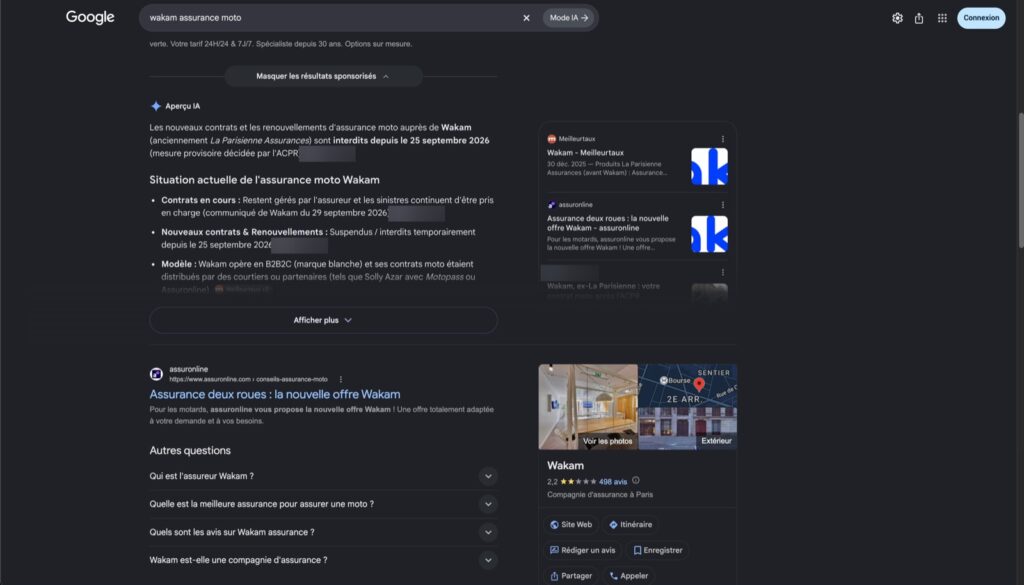
To rank in AI Overviews, your page first has to be easy to quote: a direct answer in the opening lines, numbers with their source, an FAQ, a named author and fresh content. On the WordPress site of one of our clients, an insurance broker, an article built this way became the top source in Google’s AI Overview for its query, 7 days after it went live.
Key takeaways
- Cited at the top of an AI Overview within 7 days. French query « wakam assurance moto » (a motorbike insurance question), Google screenshot taken on Oct 13, 2026 in a private window.
- The 4 heaviest criteria in our scoring: FAQ and lists (18 points), direct answer (15), numbers (15), headings (12).
- SEO basics still count: title and meta description, internal links and structured data are part of the 12.
- What the article got since publication: 33 visits, 41 AI crawler hits (ChatGPT first), 20 clicks and 295 impressions in Search Console.
- Our GEO score is an in-house benchmark, not a Google ranking factor, and it does not measure whether other sites talk about you.
Below are the 12 criteria we check on every page, what each one asks for in practice, and what that article got in its first week. One case is not a rule, and AI Overviews change often: use these criteria as a checklist, not as a promise.
What does it take to appear in a Google AI Overview?
An AI Overview is the answer Google’s AI writes above the regular results, with the pages it used listed next to it. Those pages are the cited sources. Ranking in an AI Overview means being one of them.
Google is clear on one point: there is no special markup to add. AI features draw on pages that are already indexed and eligible to show a snippet in Search (Google Search Central). Being eligible is not being picked, though. What tips the balance is how easy your page is to understand, trust and quote.
Why did Google cite this page over bigger sites?
Google cited it because the article answered the question right away, was dated that week and split into blocks that were easy to quote, even against far better-known comparison sites.
Several sites had written on this news story, including well-known comparison sites. The page Google put at the top of its AI Overview came from a small insurance broker whose SEO work had only just started.
Three things stood out on a first read:
- It answers right away. The reader’s question (“what happens to my motorbike policy?”) gets its answer in the first two lines.
- It is dated and recent. On a news topic, Google needs the latest version.
- It is easy to slice. Question-style headings, lists, an FAQ: the AI can lift one block without rewriting the rest.
The article was drafted by Claude through a routine that follows our method, then reviewed and approved by our team before going live. The AI did not get it cited. The structure we forced on it did.
Which 12 criteria help a page get cited by AI?
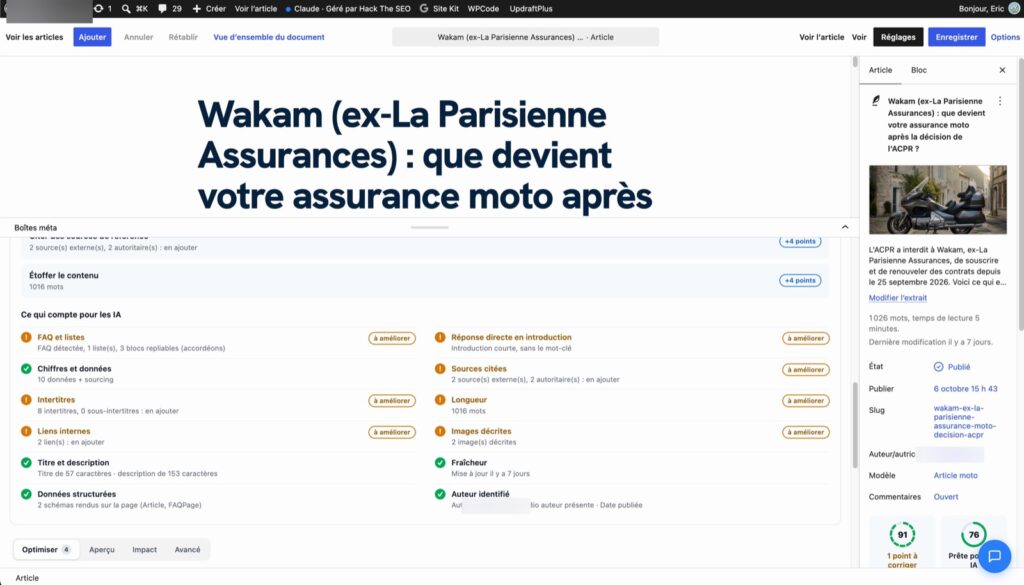
The 12 criteria are FAQ and lists, a direct answer, numbers, headings, sources, length, internal links, described images, title and description, freshness, structured data and a named author.
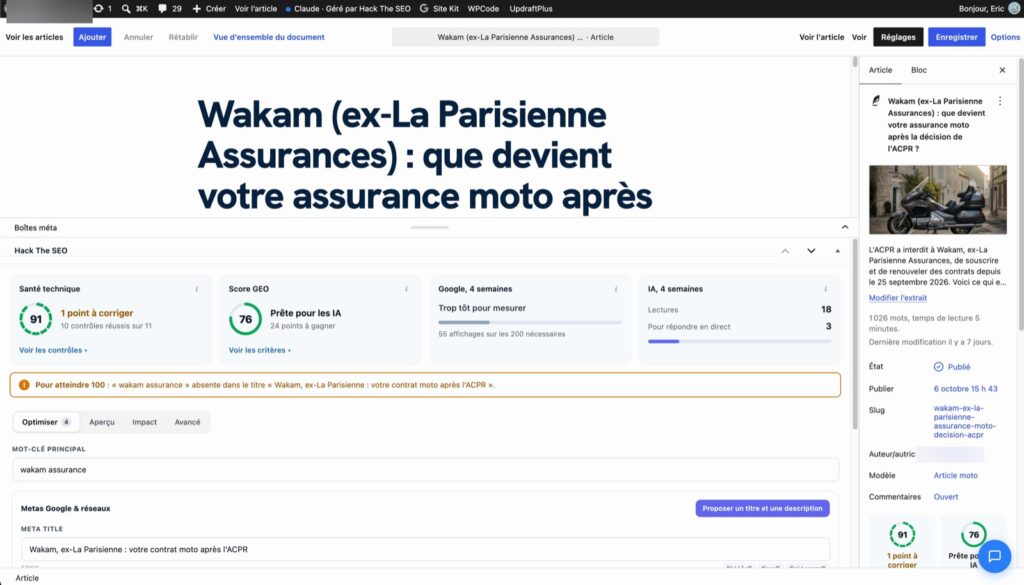
In the Hack The SEO WordPress plugin, every page gets two scores: an SEO score for classic Google, and a GEO score for AI answers. The GEO score uses 12 criteria. Here is how much each one weighs, in maximum points (from the plugin’s hts_get_geo_score tool):
| Criterion | Max points | What it asks for |
|---|---|---|
| FAQ and lists | 18 | A real FAQ built on questions people ask, plus bulleted or numbered lists |
| Direct answer | 15 | The answer to the title’s question in the first two sentences, with the topic named |
| Numbers | 15 | Specific figures, each with its source |
| Headings | 12 | H2 and H3 headings, ideally phrased as questions |
| Sources | 10 | Links to authoritative sites on the topic |
| Length | 8 | Enough text to cover the topic, no filler |
| Internal links | 8 | Links to your other pages on the same theme |
| Described images | 7 | Images with alt text that says what they show |
| Title and description | 5 | A title tag and meta description of the right length |
| Freshness | 5 | A page published or updated recently |
| Structured data | 5 | The code that tells Google “this is an article, this is an FAQ” |
| Author | 5 | A named author with a short bio |
The total is 113 points, scaled to 100. The first four criteria alone are worth 60 of the 113 points: if you only fix four things, fix those.
How do you write a direct answer AI Overviews can lift?
A direct answer restates the title’s question and answers it in the first or second sentence, in two or three sentences that make sense without reading the rest of the page.
The direct answer is worth 15 points, and it is usually the quickest fix:
- Restate the title’s question and answer it in the first or second sentence. No warm-up paragraph.
- Name the topic in that first sentence. In the video, Claude spots that the words “motorbike insurance” are missing from the article’s first sentence, and rewrites it.
- Keep it short: two or three sentences that stand on their own. Copied alone, they should still answer the question.
This is the paragraph an AI is most likely to quote word for word. The rest of the page is there to back it up.
Why do sourced numbers and an FAQ matter so much?
Sourced numbers and an FAQ matter because they give the AI verifiable facts and ready-made questions and answers it can reuse as they are, with little risk of getting things wrong.
An AI writing an answer looks for facts it can verify. A number with its source (“according to this study, on this date”) is a fact it can reuse safely. A number with no source is one it has reasons to skip. The Princeton researchers who coined “GEO” tested this: adding statistics, quotations and cited sources is among the levers that make a text more visible in AI answers (GEO study, Princeton, KDD 2024). If Claude or ChatGPT helps you write, keep the sources it gives you in the article, and check them. If your company has its own data, a survey, a measurement, an anonymized customer figure, publish it with its proof.
The FAQ does the same job for questions: each Q&A is a self-contained block an AI can cite as is. Take your questions from the “People also ask” box on your target query: those are the ones people actually type.
To be fair: our scoring measures how a page is built, not its reputation. It cannot see whether other sites mention you, or how much Google trusts you on the topic. A page scoring 100 may never be cited, and a weaker one may be.
Do author, freshness and schema really matter for AI Overviews?
Yes: author, freshness and structured data are worth 5 points each, take minutes to fix and tell Google who wrote the page, when, and what kind of page it is.
Author
A name, a short bio and a link to a public profile (LinkedIn is the easiest). Google asks pages to show who wrote them and why they can be trusted (Google, helpful, reliable, people-first content).
Freshness
A visible publication date, and an update whenever the topic moves. On news, the most recent page has the edge.
Structured data
Invisible code telling Google the page is an article, has an FAQ, and who wrote it. Our plugin adds it automatically based on the page type (blog post, product page…).
Title, meta description and internal links work exactly as in classic SEO. AI does not replace the basics.
What did the article get in its first week?
In its first week, the article got 33 visits, 41 AI crawler hits, 20 clicks and 295 impressions in Google, according to the Hack The SEO plugin and the client’s Search Console.
The details, read on Oct 13, 2026, since publication:
- 33 visits to the article since it went live
- 41 AI crawler hits, ChatGPT first
- 20 clicks from Google (Search Console)
- 295 impressions in Google (Search Console)
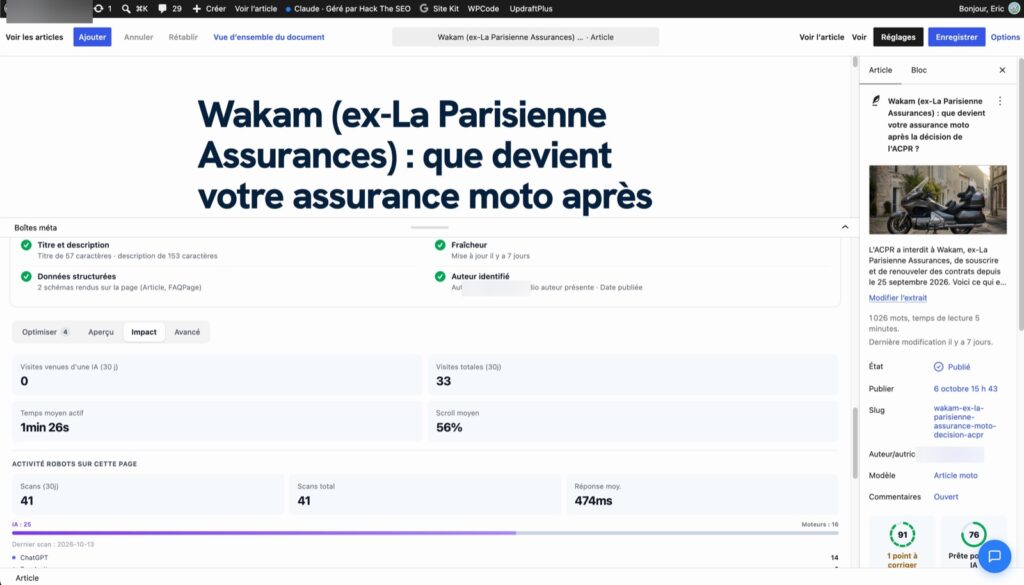
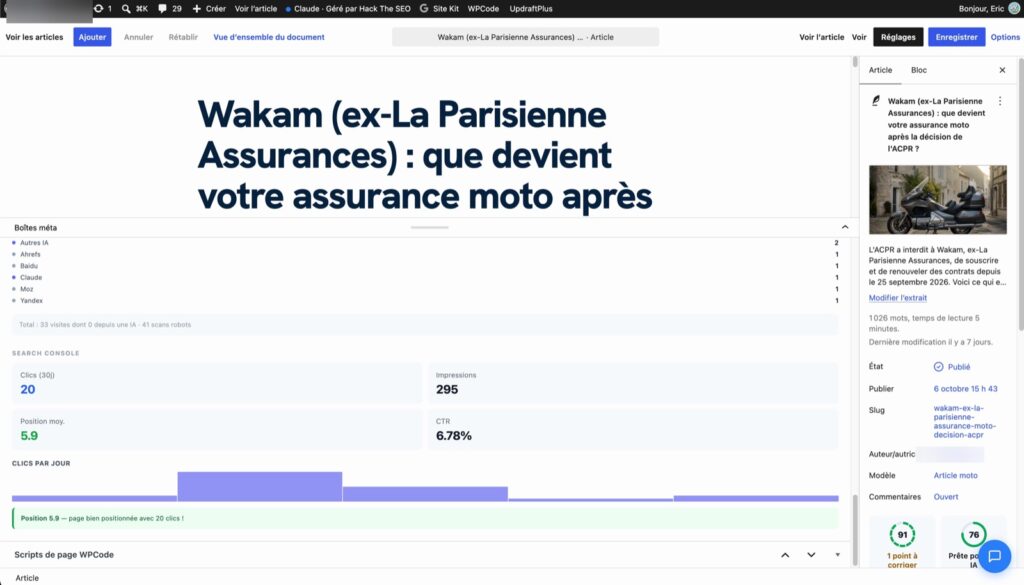
Two caveats. A crawler hit is not a citation: it shows an AI read the page, not that it recommends it (more in our post on AI crawlers on WordPress). And Search Console does not split AI Overview clicks from other Google clicks, nor does it see ChatGPT at all (see why Search Console misses ChatGPT traffic).
How can Claude optimize a page for AI Overviews?
With Claude connected to Hack The SEO, you ask for a page’s GEO score review: it reads the method and the data, proposes fixes, and you approve each one in a click.
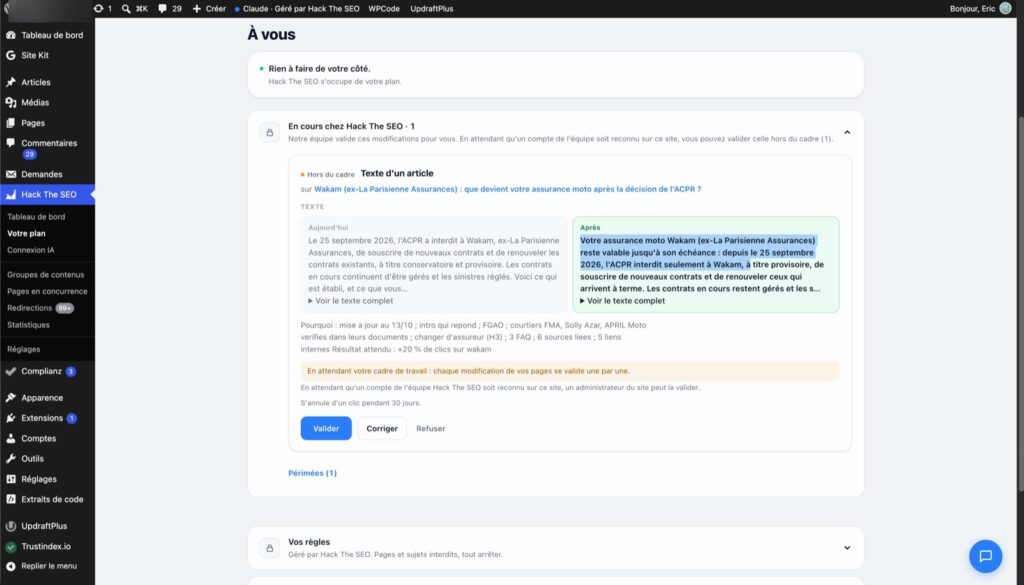
In the second half of the video, we simply ask Claude, connected to the Hack The SEO plugin, to analyze the article’s GEO score and improve it. It reads our method, the page score, Search Console and crawler data, then proposes a plan.
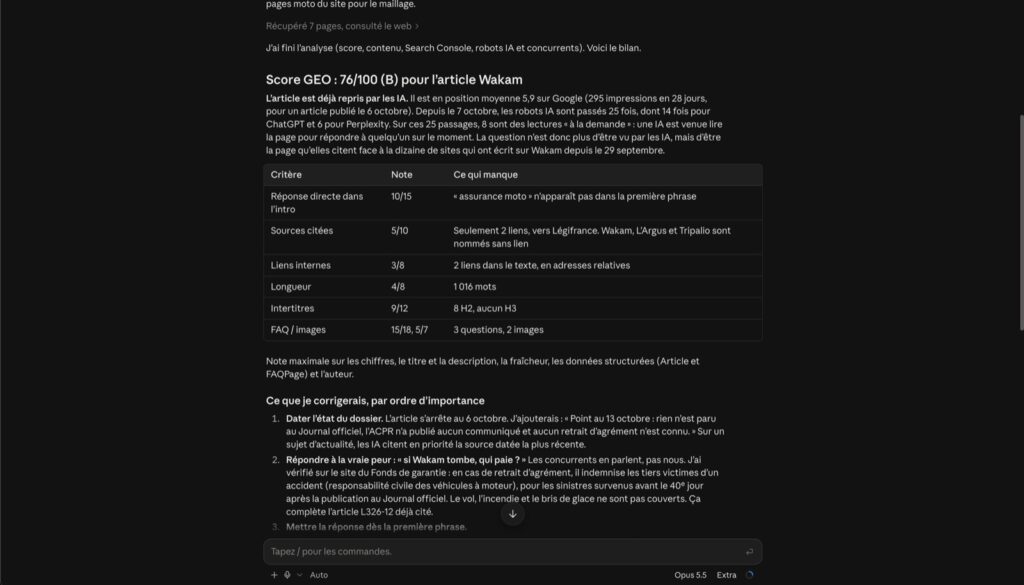
One detail worth noting: it did not chase the score. It first checked whether the story was still current and looked for the latest news, then rewrote the intro. Scores point the AI to weak pages and weak spots; they are not the goal.
Nothing goes live without you. Each change is filed for approval, you see the before and after, you approve in one click, and every applied action can be undone for 30 days. Same logic as a WordPress SEO audit run with Claude.
A test you can run today: open your most important article and read only its first two sentences. If they do not answer the title’s question, start there. To check the other 11 criteria at once, see the GEO score of every WordPress page, or run a WordPress SEO audit.
FAQ
How do you rank in Google AI Overviews?
Your page has to be indexed and rank for the query first. Then it has to be easy to quote: a direct answer up top, sourced numbers, an FAQ, clear headings, a named author and up-to-date content. No tag guarantees a spot.
Is there special markup to get cited in an AI Overview?
No. Google says there is nothing extra to add for its AI features. Structured data helps Google understand the page, but it is not enough to get cited.
Does llms.txt help with Google AI Overviews?
There is no evidence it does for Google. The file targets other assistants. For AI Overviews, page quality and structure are what count.
How long does it take to get cited?
There is no set delay. In our case, 7 days after publication, on a news topic. That is one case: on a competitive topic it will often take longer, or never happen.
Is the Hack The SEO GEO score a Google ranking factor?
No. It is an in-house benchmark built on what AI answers tend to reuse. It measures how your page is built, not your reputation or brand mentions elsewhere.
Does an AI Overview citation bring traffic?
Sometimes. Some readers stop at the answer; others click the source. Our article got 20 Google clicks and 33 visits since publication, and there is no way to tell which came from the AI Overview.
Do the same criteria work for ChatGPT?
Mostly: a direct answer, sourced facts and an FAQ are easy for any AI to reuse. But ChatGPT has its own crawlers and sources, so it also has to be able to read your page.
Further reading
- GEO score for WordPress: are your pages ready for AI?
- How to run a WordPress SEO audit with Claude
- AI crawlers on WordPress: who reads your site
- Search Console misses ChatGPT traffic: where to find it
- SEO and GEO statistics
Want to see where your pages stand? We open your WordPress site together, check the GEO score of your key pages and what to fix first. Talk to an expert (free 20-minute video call). The Hack The SEO plugin is €249 excl. VAT per month, no commitment.
Sources
Our data
- Google, French query « wakam assurance moto » in a private window, screenshot taken Oct 13, 2026: an insurance broker’s article cited at the top of the AI Overview, 7 days after publication.
- Hack The SEO plugin, Oct 13, 2026: SEO score 91; GEO score on the 12-criterion scale; 33 visits and 41 AI crawler hits since publication.
- The same site’s Search Console, since publication: 20 clicks, 295 impressions.
- GEO score weights: Hack The SEO
hts_get_geo_scoretool.
Documentation