The topic cluster generator for WordPress that builds itself.
Building a topic cluster by hand takes weeks: topical mapping, writing, linking. Hack The SEO does it in minutes, right inside your WordPress admin, and keeps it up to date on its own.
What is a topic cluster?
A topic cluster is a group of pages that covers one subject in depth: a central pillar page targets the main query, cluster pages answer every related question, and deliberate internal links push their combined authority up to the page that sells.
Popularized by HubSpot — whose own topic cluster tool has since been retired — the model is known in French SEO as the cocon sémantique (semantic cocoon). It remains the most reliable way to build topical authority: for Google, and now for the AI engines that pick their sources.
The theory was never the problem. Execution is: a real cluster means a topical map, 10 to 15 articles and dozens of internal links — three jobs at once. Most topic cluster generators hand you a map or a spreadsheet and stop there. Hack The SEO builds the whole thing inside WordPress.
You know you need topic clusters. Building them by hand is a project.
Mapping the topics, writing 12 articles, placing the right links, starting over when content changes... Most topic clusters never see the light of day. Knowing is not the problem. Executing is.
- An audit that tells you "your pages don't talk to each other" and builds nothing
- A cluster map you have to execute yourself, spreadsheet in hand
- Articles to write one by one, for weeks
- Internal links to place one by one, and redo after every redesign
- The Topical Map generated in under a minute from your real content
- Missing articles written by AI, delivered as drafts
- Internal links placed automatically toward the pillar page
- A topic cluster that updates itself when your content changes
Three clicks, one complete topic cluster.
Everything happens in Hack The SEO, in the Content Groups tab. No technical skills required.
Detect your pillar pages
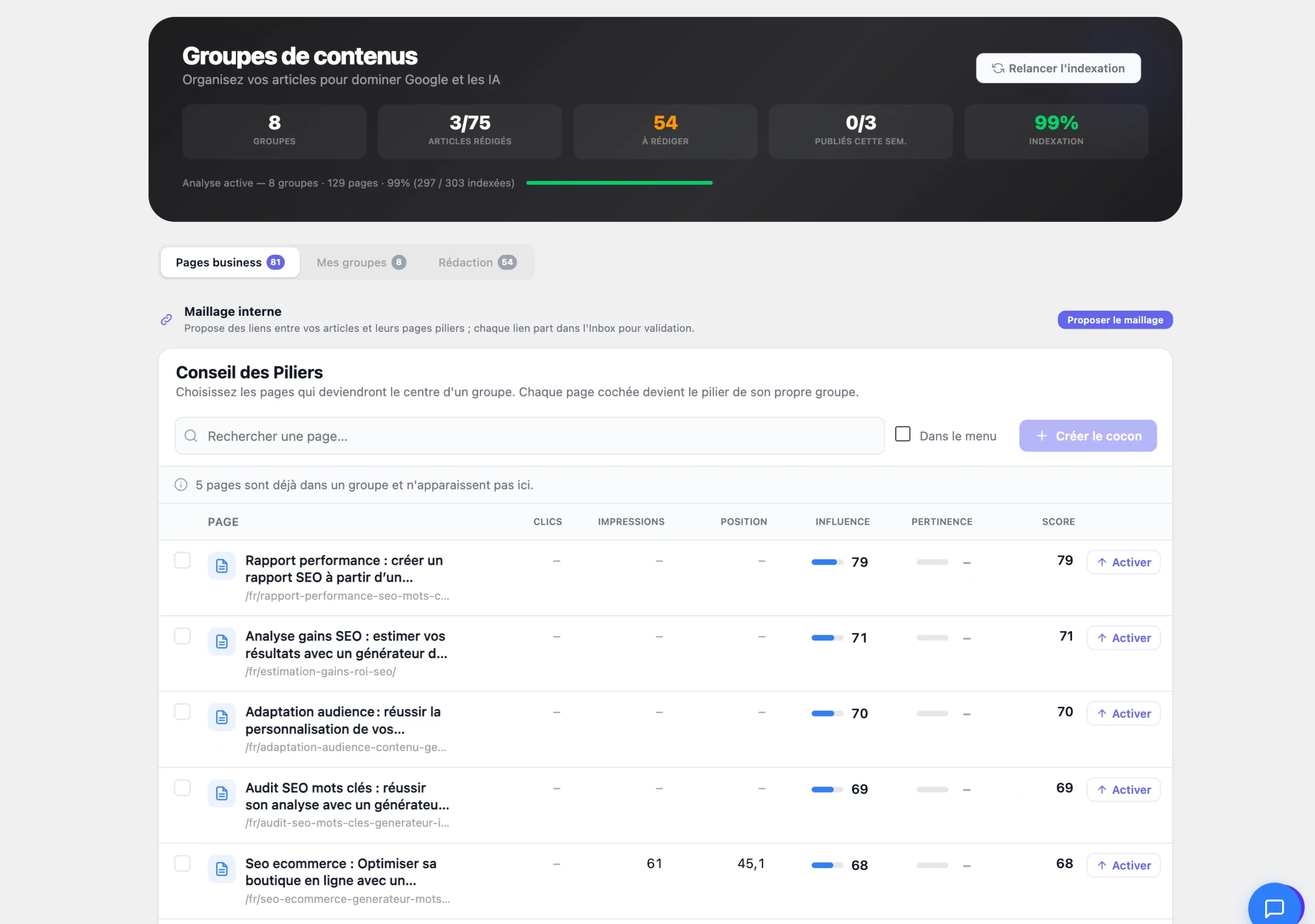
The plugin scans your site and suggests your business pages: the ones that need to rank. You tick your pillars. N pillars ticked, N topic clusters built.
Group content by meaning
Every piece of content is analyzed for its meaning, not its keywords or tags. The plugin sorts each article around the right pillar page: off-topic content never pollutes the cluster.
Write and link in 1 click
AI writes the missing cluster articles, delivered as drafts, never published without you. Internal links are placed toward the pillar. You approve, it goes live.
Your pillar pages detected, not guessed.
A topic cluster is built around a page that makes money: a service, a category, an offer. The plugin identifies these business pages in your real site and suggests them. You tick, it builds.
- Automatic detection of your highest-stakes commercial pages
- One pillar page ticked = one topic cluster built around it
- Works on your existing site: nothing to restructure before you start
Grouped by meaning, not by tags.
Two articles can share a category without covering the same subject. The engine compares the real meaning of your content to compose each cluster: that is what makes it coherent, one Google and AI engines can actually read.
Every piece of content is represented by its semantic fingerprint. Two pages about the same thing end up together, even without words in common.
An off-topic article never enters the cluster, even if it shares tags or a category with the pillar page.
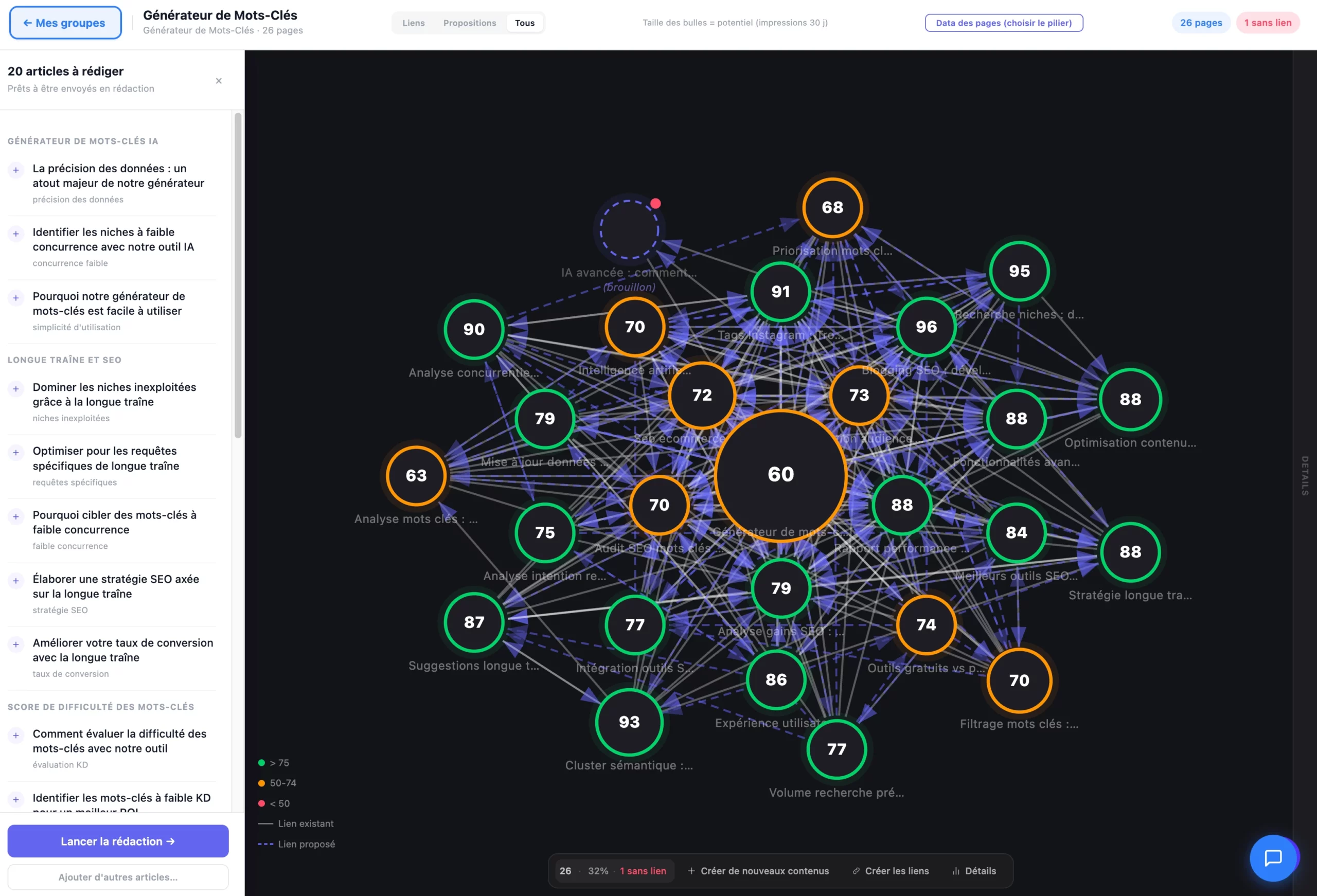
Pillar page, cluster pages, supporting articles: each level reinforces the next, and authority flows up to the page that sells.
Three levels, one goal: push authority up.
Pillar page, cluster pages and supporting articles reinforce each other. That is what turns a WordPress site into a topical authority, for Google and for the AI engines that pick their sources.
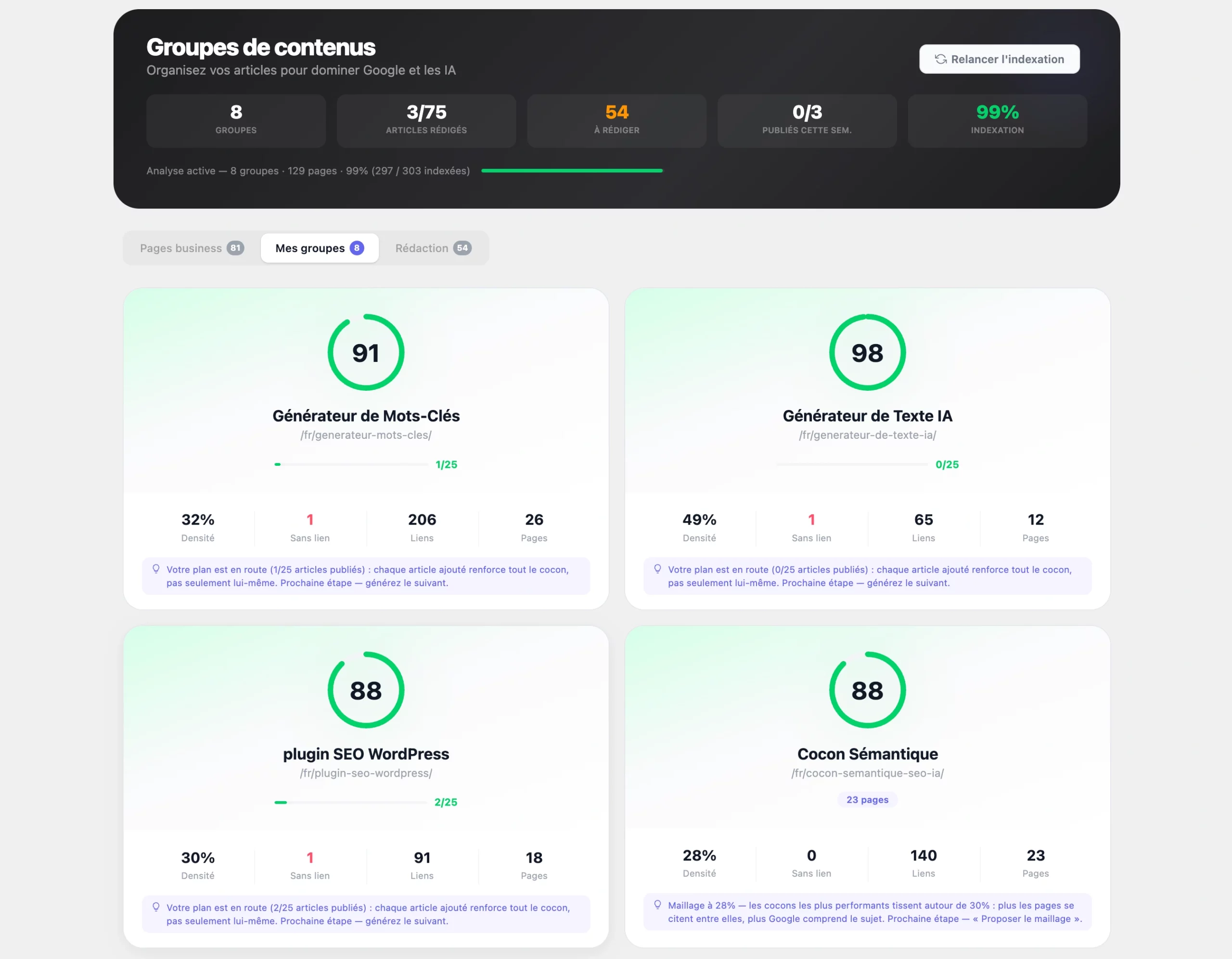
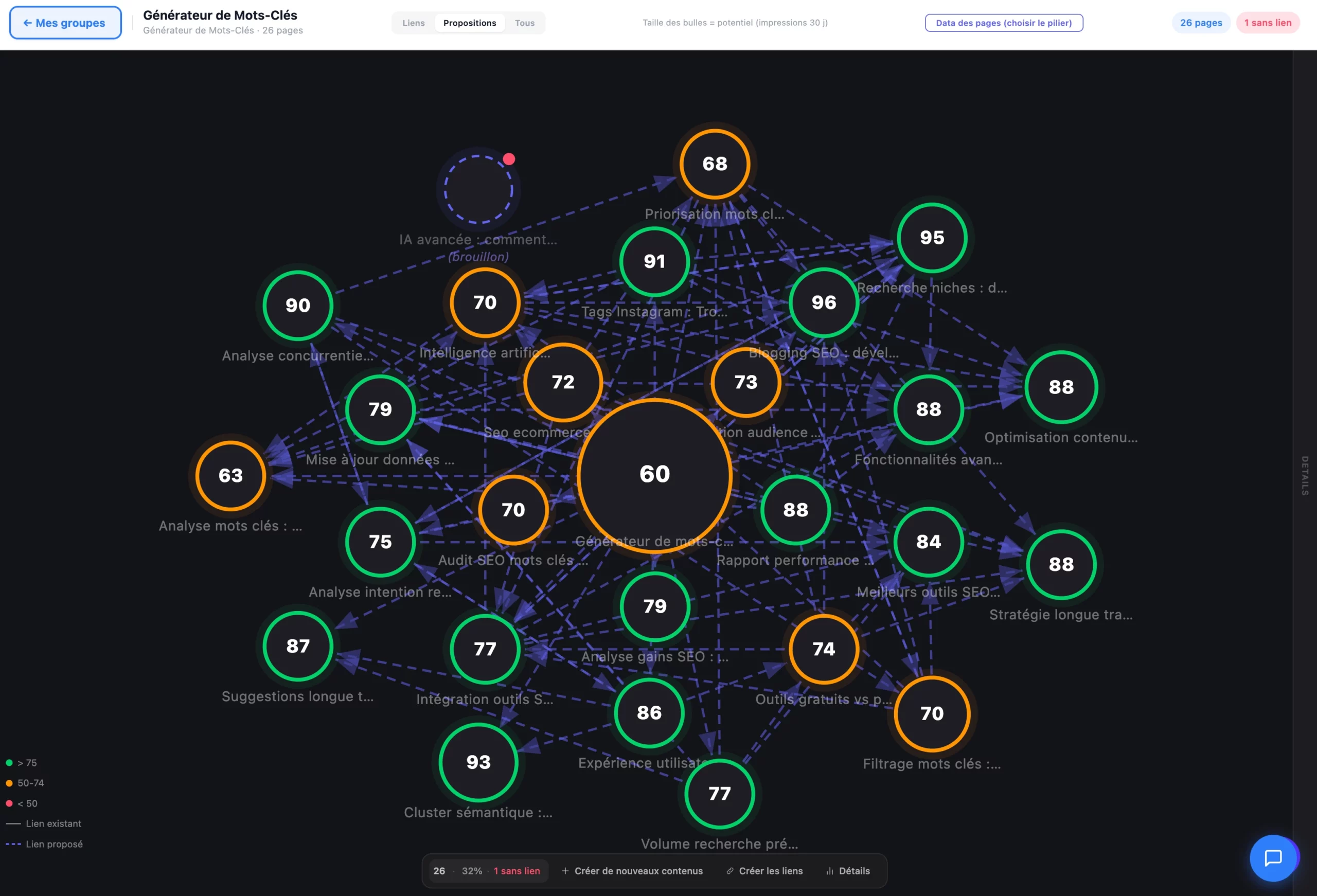
- The cluster graph visualized in your admin: pillar page at the center, cluster pages and supporting articles around it
- A score per cluster: you see which ones are complete and which are missing articles
- Topical authority generative engines can read: every cluster feeds your GEO Score
Gaps filled, links placed.
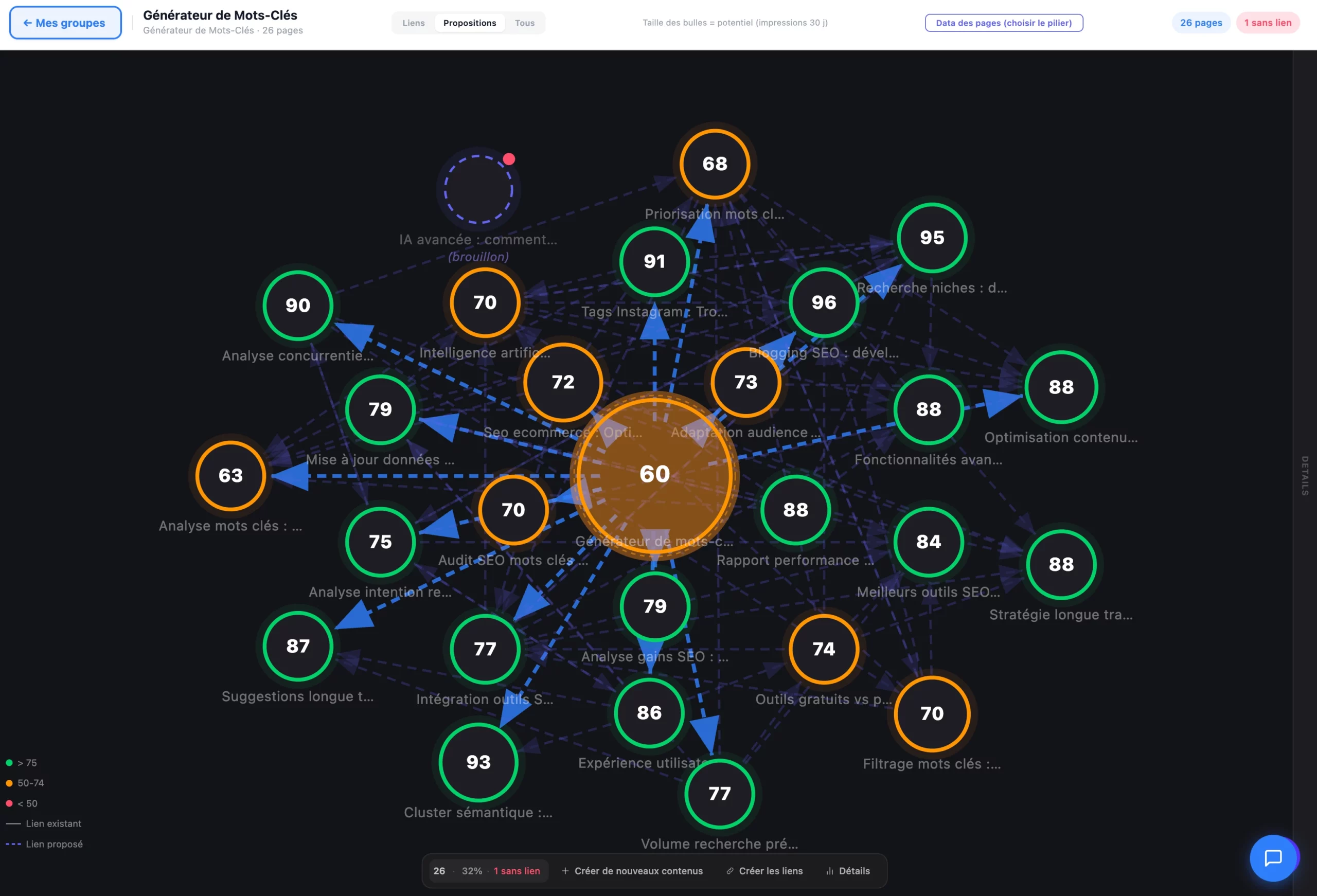
An incomplete cluster does not rank. The plugin detects the missing topics, writes them to the SEO + GEO score criteria, then places the internal links toward the pillar page: in the real content, not in a widget.
Every gap in the cluster becomes a full draft: outline, writing, metas and links. You review and publish. Details on the AI SEO writer.
Suggested anchor, targeted paragraph, inserted in Gutenberg, Elementor or Divi. Every link stays reversible for 30 days: see automatic internal linking.
New article, edited content: the cluster recalculates and suggests adjustments. It lives with your site.
From pillar page to living cluster, six capabilities.
Topical Map in 60 s
The complete map of your topics, generated from your real content: pillar pages suggested, clusters sketched, gaps identified.
Pillar pages detected
Your business pages identified automatically. You tick, each pillar becomes the center of a topic cluster.
Clusters by meaning
Content is sorted by semantic analysis, not tags. Off-topic articles stay out.
Score per cluster
Completeness, linking, freshness: every topic cluster has a score. You know which one to work on first.
Missing articles written
Absent topics are written to SEO + GEO criteria and delivered as drafts in the Inbox.
Links placed + rollback
Links inserted in the real content, whatever the builder, reversible for 30 days in one click.
Topic clusters, for your type of site.
Blogs & media
One cluster per core topic: long-tail articles feed the pillar page, authority rises, rankings follow.
E-commerce
The category becomes the pillar page, the blog sells: 3 to 5 articles per product cluster are enough. See WooCommerce SEO.
Services & B2B
Every offer gets its cluster: your sales pages stop being orphans and receive the authority of your content.
Agencies
One topic cluster per client, delivered in days instead of weeks: the margin is in the automation, not the all-nighter.
Topic clusters that actually rank.
Real numbers, sourced from Semrush and Google Search Console, verifiable in a demo.
"A 40-page cluster published in 3 weeks. +177% traffic in the first month. The auto-linking did what an agency would take 6 months to do."
"30 articles in 60 days through topic clusters. Semrush traffic 3.3x and 216% more keywords in the top 3. Without touching a thing by hand."
"130 Elementor pages that never talked to each other. Now every page reinforces the others automatically. My team never touches internal linking anymore."
"Everyone knows they need topic clusters. Almost no one builds them, because it's three jobs at once: strategist, writer, integrator. Our job is to make those three jobs fit in one click."
The automatic topic cluster generator: no one else does this.
| Capability | Yoast | Rank Math | SEOPress | Hack The SEO |
|---|---|---|---|---|
| Automatic topical mapping (Topical Map) | ✕ | ✕ | ✕ | ✔ |
| Clusters built by meaning, not by tags | ✕ | ✕ | ✕ | ✔ |
| Writing the cluster's missing articles | ✕ | ✕ | ✕ | ✔ |
| Internal links placed in 1 click | ✕ | ✕ | ✕ | ✔ |
| A topic cluster that updates itself | ✕ | ✕ | ✕ | ✔ |
Frequently asked questions about topic clusters.
What is a topic cluster, in plain terms?
Is a topic cluster the same as a semantic cocoon?
What is the best topic cluster tool for WordPress?
Does the plugin really build the topic cluster on its own?
Are articles published automatically?
How many articles in a topic cluster?
Does it work with Elementor, Divi, Gutenberg?
How long before a topic cluster shows results?
Can a topic cluster cannibalize my existing pages?
How is this different from an agency-built cluster?
Which plan do I need for topic clusters?
Watch a topic cluster build itself on your site.
20 minutes on a call. We take your topic and show you the cluster generated, written and linked live, with the plugin installed on your WordPress.
On your site, not a generic demo · free 1.5-hour expert onboarding · traffic up in month one, or refunded