Bruno and I have been doing SEO for fifteen years. We wrote a book on it (published by Dunod), we optimize more than 1,300 sites today, and we watch GPTBot, ClaudeBot and PerplexityBot hit those sites in real time. In other words, we don’t theorize: we watch the curves move. I’ve pulled together more than 150 statistics (US, worldwide and France), all dated and sourced. My goal isn’t to scare you, it’s to give you a head start. My take fits in one line: SEO isn’t dead, it’s changing ground.
The essentials in 6 points
- AI Overviews have been live in France since July 22, 2026. The countdown has started for your organic traffic.
- An AI Overview halves the click: 8% of clicks instead of 15% (Pew, US). In the UK, desktop CTR has already dropped by nearly half.
- Zero-click is becoming the norm: nearly 60% of searches end without a site visit, up to 68% in the US.
- Good news, people search more, not less: +21.6% Google volume in 2024, and Google still holds 88.7% in France.
- The real work is GEO, and France has an asset: Mistral and its Le Chat app (1 million downloads in two weeks).
- What still holds: human, expert content (~80% of #1 positions), the brand, semantic silos and structured data.
1. AI Overviews have landed in France (yesterday)
Let’s start with the news that prompted this article. On July 22, 2026, Google made the rollout of AI Overviews and AI Mode in French search official, in French (Google, Blog du Modérateur, 2026). The AI summary sits at the very top of the page. AI Mode turns search into a conversation. Both share one thing: they answer instead of your site.
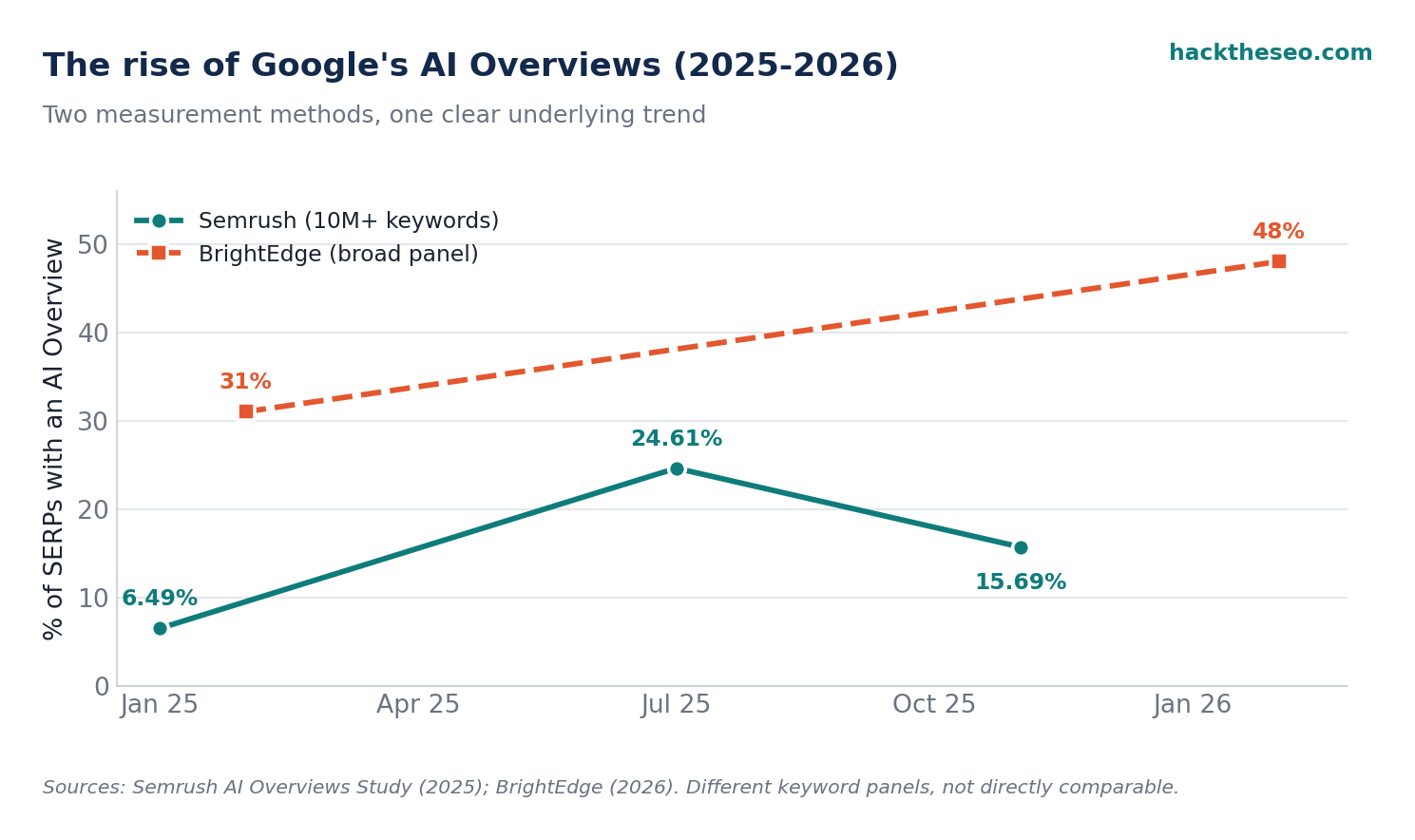
Worldwide, AI Overviews already claim 2 billion monthly users (Alphabet, 2025). Their presence climbed fast in 2025, then leveled off. According to Semrush, the share of SERPs showing one went from 6.49% in January to 24.61% in July 2025, before falling back to 15.69% in November. Another tool, BrightEdge, measures a much wider presence, around 48% in early 2026. The truth sits between the two, and it depends mostly on your queries.
Two things to know about the French version. First, Google committed to paying 450 contracted French media outlets when their content feeds an AI Overview. Second, a publisher can opt out of appearing in them without losing its ranking. That flexibility comes straight from the €250 million fine handed down by France’s competition authority in March 2024, over the neighboring-rights case. So the French framework is a bit more protective than elsewhere. A bit. It won’t give you back the clicks you lose.
EMy takeThe real news today isn’t the launch, we saw it coming. It’s that we have a full year of data from the US, the UK and Germany to know exactly what’s coming. No need to wait for your curves to dive in Search Console: the film has already been shot elsewhere.
My very concrete advice for this weekend: list your 20 pages that drive the most traffic. The ones that answer a question (how, why, definition) are the most exposed. Those are the ones to protect first. On our end, that’s exactly what we automate inside the plugin, but you can start by hand today.
2. We search more, we click less
Before we get to the click collapse, let’s set one thing straight, because there’s a lot of nonsense going around. No, search is not collapsing. Google handles more than 5 trillion searches a year, about 14 billion a day, and its volume actually grew +21.6% in 2024 (Google; SparkToro, 2024-2025). We search more than ever.
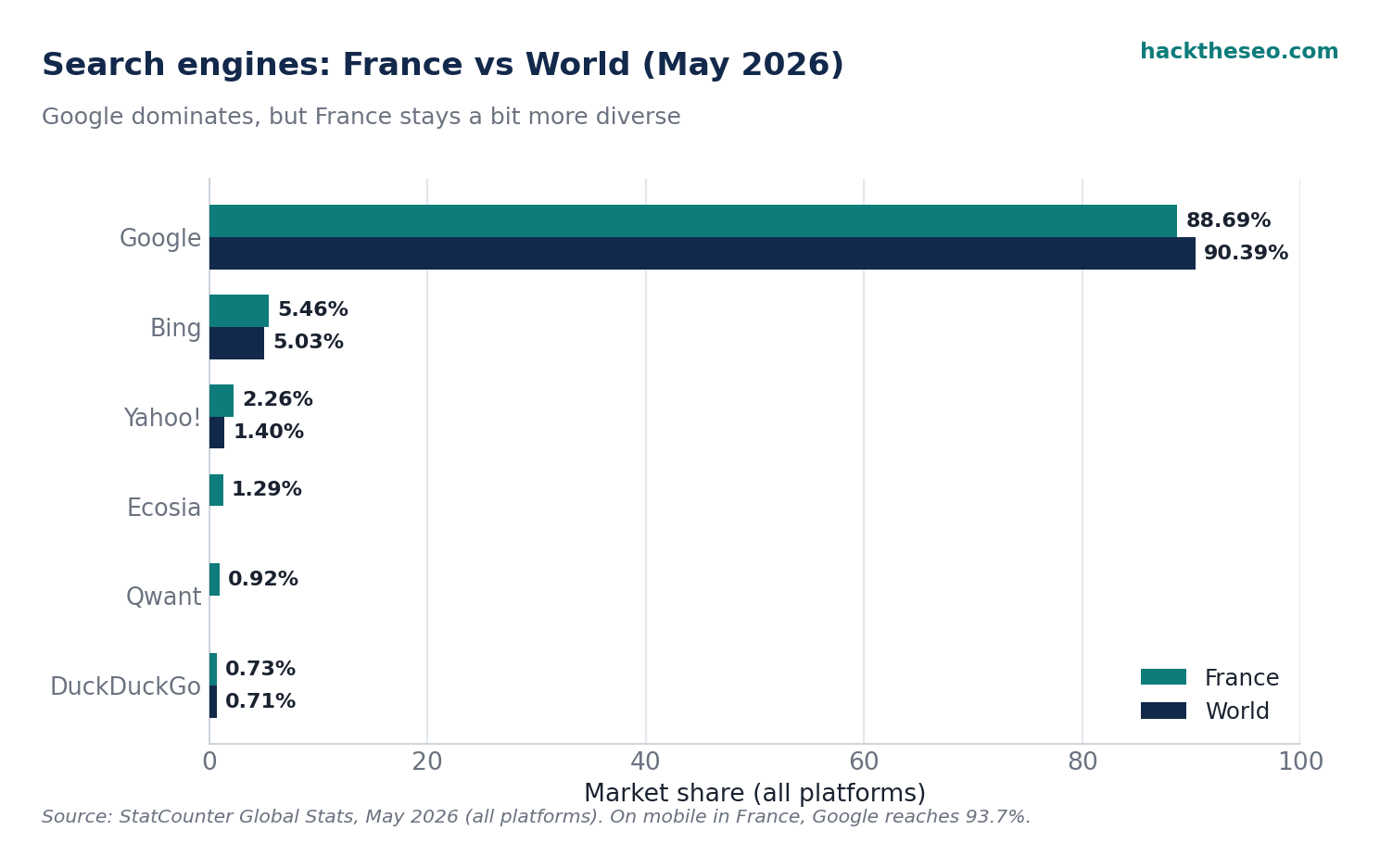
And Google stays overwhelming, especially in France: 88.69% market share across all platforms (May 2026), and up to 93.7% on mobile (StatCounter, 2026). A small surprise along the way: France is even a touch less “Google-ized” than the global average (90.39%), thanks to Bing, Ecosia and Qwant picking up a few points.
So here’s the real issue. The search pie is growing. The slice that lands on your site is shrinking. The whole story of 2026 lives in that gap.
3. The click collapse, the numbers that hurt (and what’s coming for France)
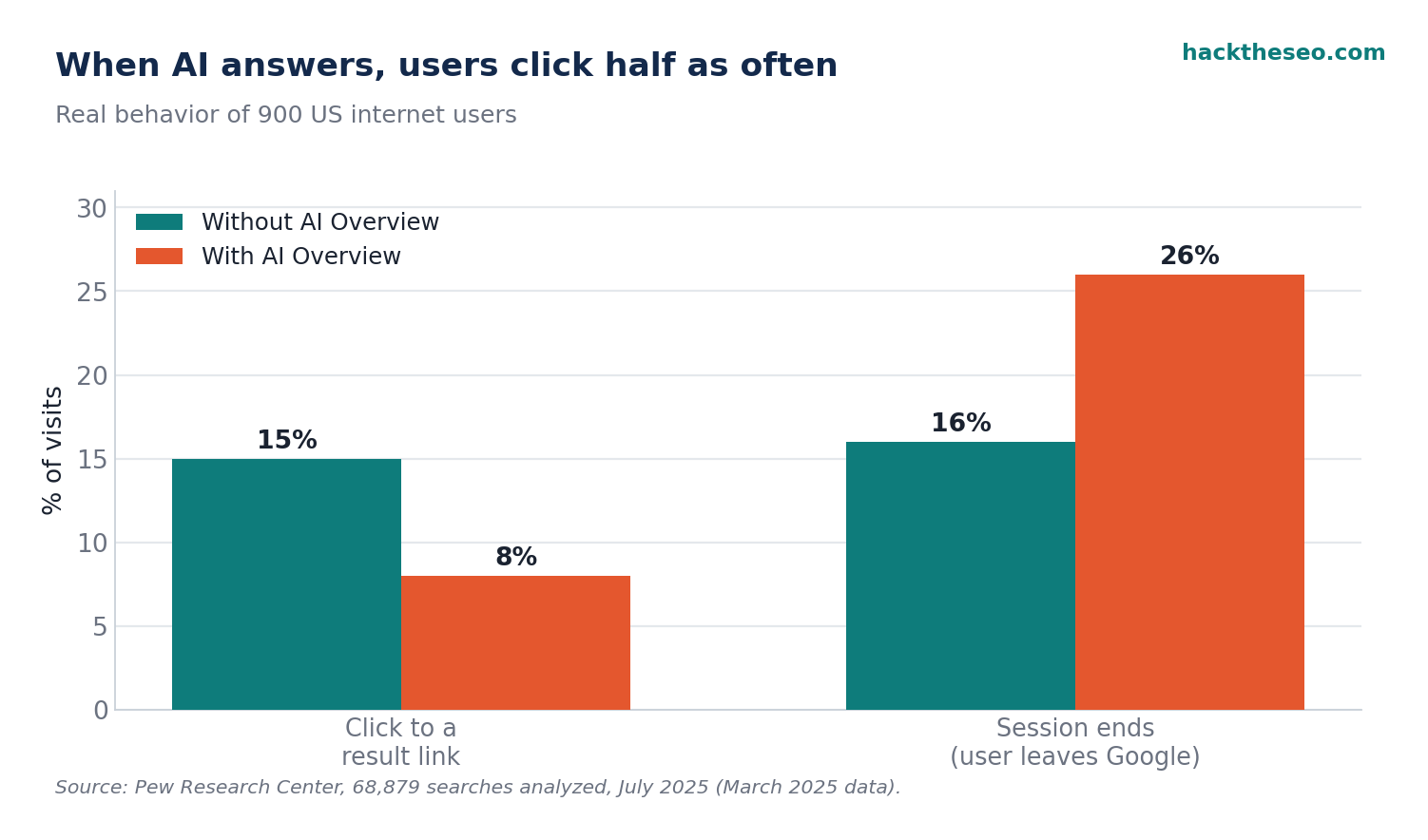
This is the heart of it, and the best data comes from the US. The most solid study is from the Pew Research Center, which observed the real behavior of 900 internet users across nearly 69,000 searches. The result is clear: when an AI Overview shows up, users click a regular link only 8% of the time, versus 15% without a summary. And they leave Google entirely (end of session) 26% of the time, versus 16% normally.
On the pure SEO side, every firm that has measured lands on the same verdict, whatever the country:
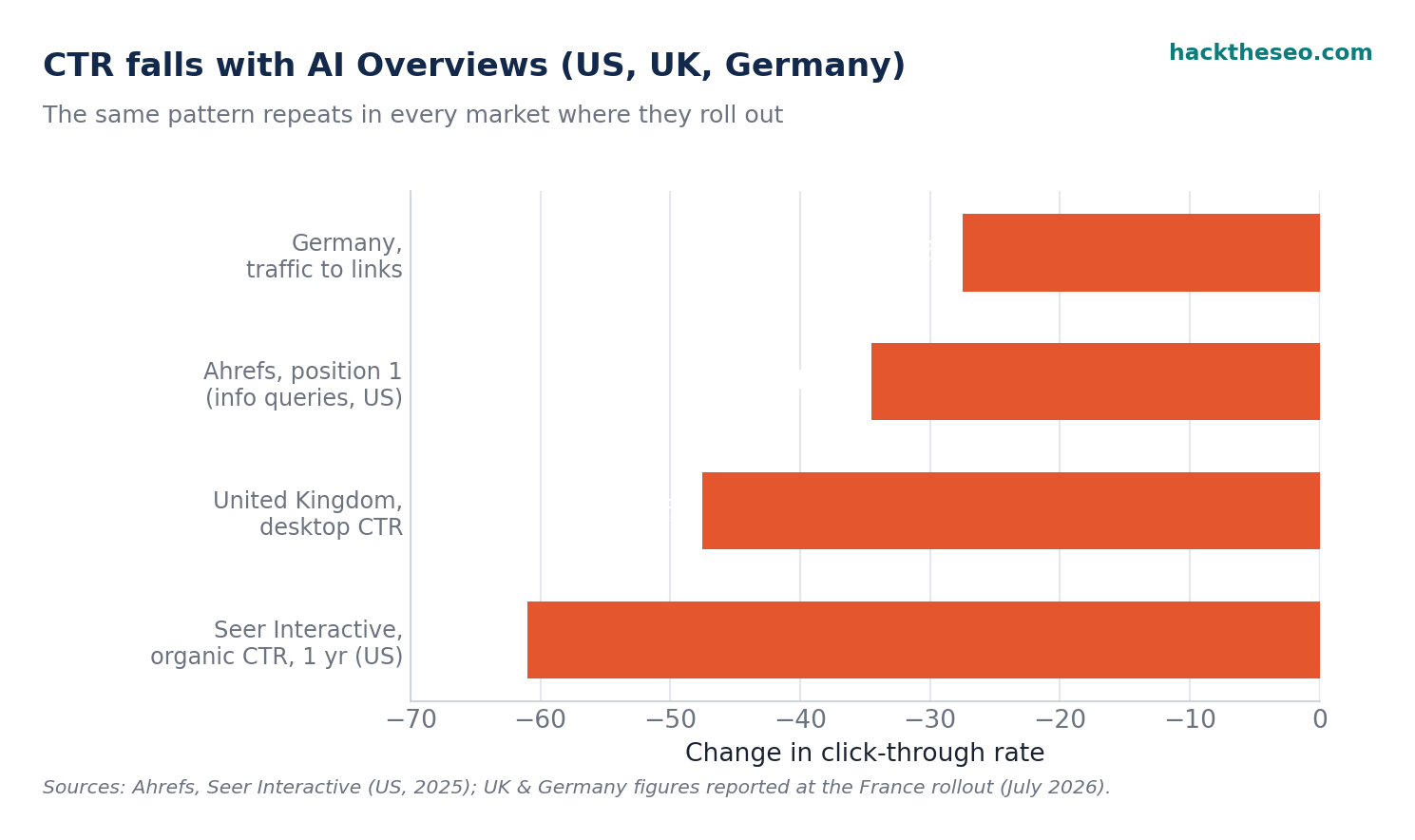
EMy takeIf the UK loses nearly half its desktop CTR, don’t imagine France will be spared. My cautious estimate: 20% to 40% fewer clicks on your informational pages within six to twelve months. Your transactional and brand pages will move far less.
And that’s where the real lesson sits: the brand protects you. Branded keywords see their CTR climb (+18.7% at Amsive) while generic terms collapse. Being cited inside the AI Overview also earns +35% organic clicks. Translated for a small-business owner: you’re no longer just playing for ranking, you’re playing for people knowing you and AI citing you. Those are two very different jobs from the SEO of yesterday.
4. Zero-click, the new normal
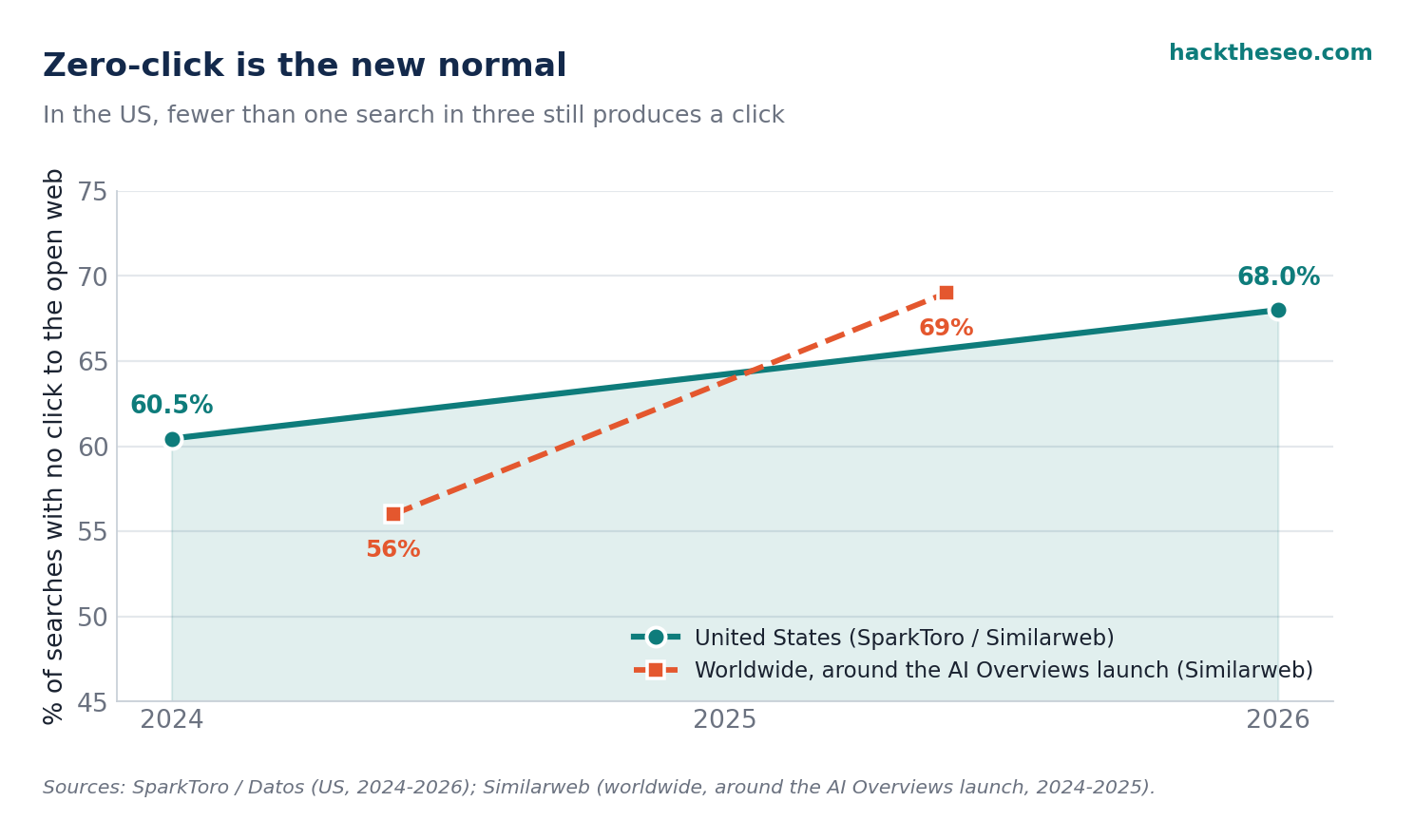
The trend goes well beyond AI Overviews alone. In the US, fewer than one Google search in three still leads to a visit to the open web. Zero-click went from 60.45% in 2024 to 68% in 2026 (SparkToro, 2026). Worldwide, Similarweb measured a jump from 56% to 69% in the year following the AI Overviews launch. Europe isn’t safe either: the same source already put EU zero-click near 60% in 2024, before AI Overviews. So we’re starting high.
Bain estimates that about 60% of searches now end without a visit, meaning 15% to 25% less organic web traffic. And the statistic that puts everyone back in their place: 96.55% of web pages get no traffic from Google. None (Ahrefs, 14 billion pages).
EMy takeStop judging your SEO by clicks alone. In 2026, on the sites we run, I watch three more things. One: impressions, because an appearance with no click is still a free brand touchpoint. Two: branded search volume, the real thermometer of your awareness. Three: AI bot visits (GPTBot, ClaudeBot, PerplexityBot) and your citations in their answers. Almost nobody measures that last one yet. That’s exactly why we built it into our tracking: what you don’t measure, you can’t manage.
5. GEO, the real battleground (and the French card: Mistral)
If clicks are moving to AI, the logic is simple: you have to be inside the AI. That’s the job of GEO, generative engine optimization. It’s the most important project of the decade, and oddly the one that statistics roundups talk about the least.
The usage numbers are huge: ChatGPT claims 800 million weekly active users and 2.5 billion queries a day, and the Gemini app is nearing 950 million monthly users (OpenAI, Alphabet, 2025-2026). But keep a cool head: AI hasn’t replaced Google yet. AI tools account for barely 3% of searches, and Google gets about 210 times more queries than ChatGPT. Anyone telling you to drop SEO and bet everything on ChatGPT has the timing wrong.
Where you need to move fast is the traffic these AIs send back to sites. It’s exploding.
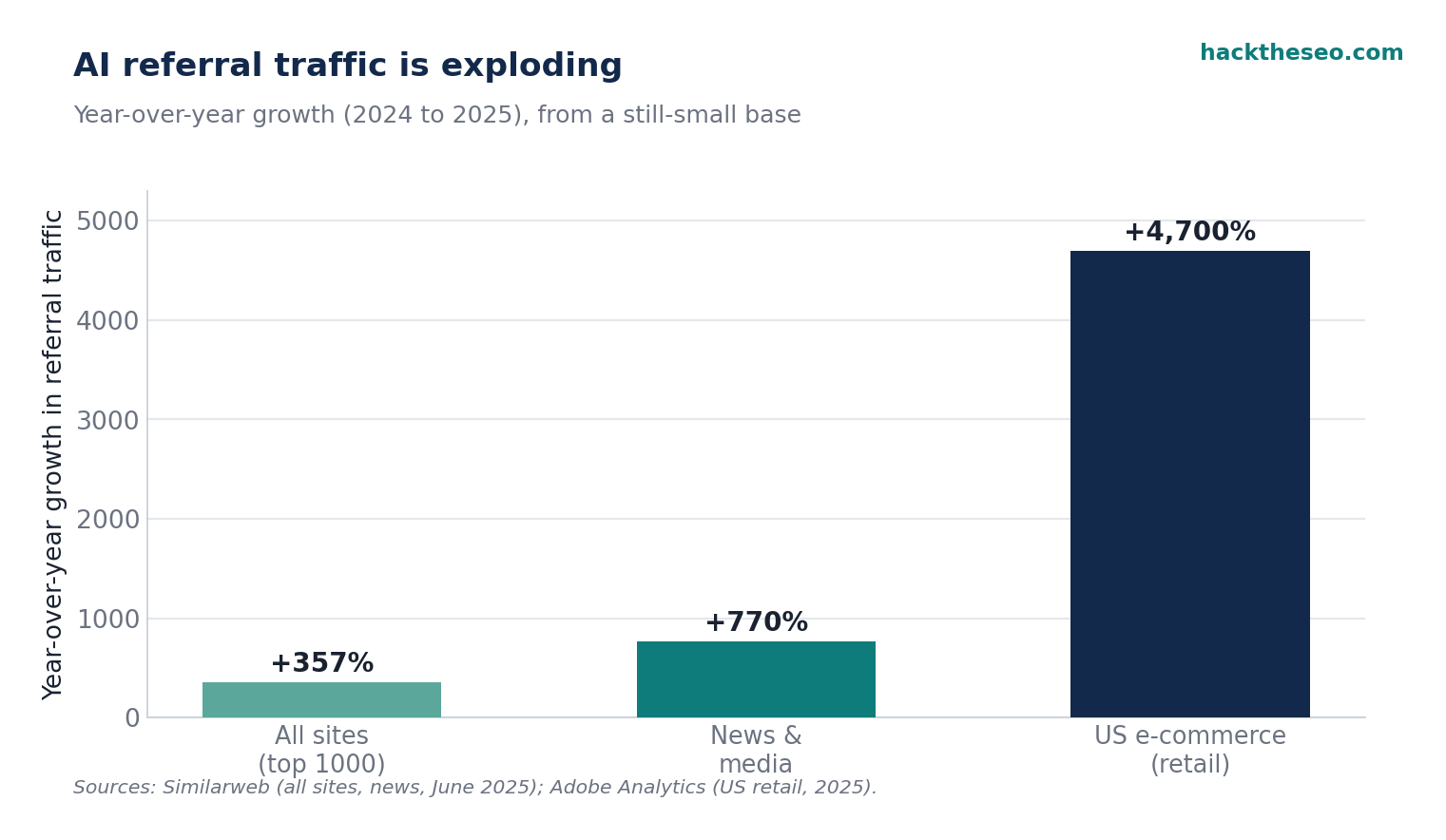
Another key signal for your strategy: the share of AI Overview citations coming from Google’s top 10 dropped from 76% to 38% in six months (Ahrefs, 2026). AIs are pulling their sources from further and further out, beyond the first page. And the domains they cite most are Reddit, Wikipedia, LinkedIn, YouTube and Google. Your presence outside your own site is becoming an SEO asset in its own right.
France’s trump card: Mistral
Here’s the angle US analyses always forget. France owns one of the few frontier LLMs in the world: Mistral AI. Its consumer app, Le Chat, passed 1 million downloads in two weeks in February 2025 and hit number one on the French App Store (franceinfo, Maddyness, 2025). For a French brand, showing up in Le Chat isn’t a detail: it’s a sovereign visibility channel, trained in part on French content.
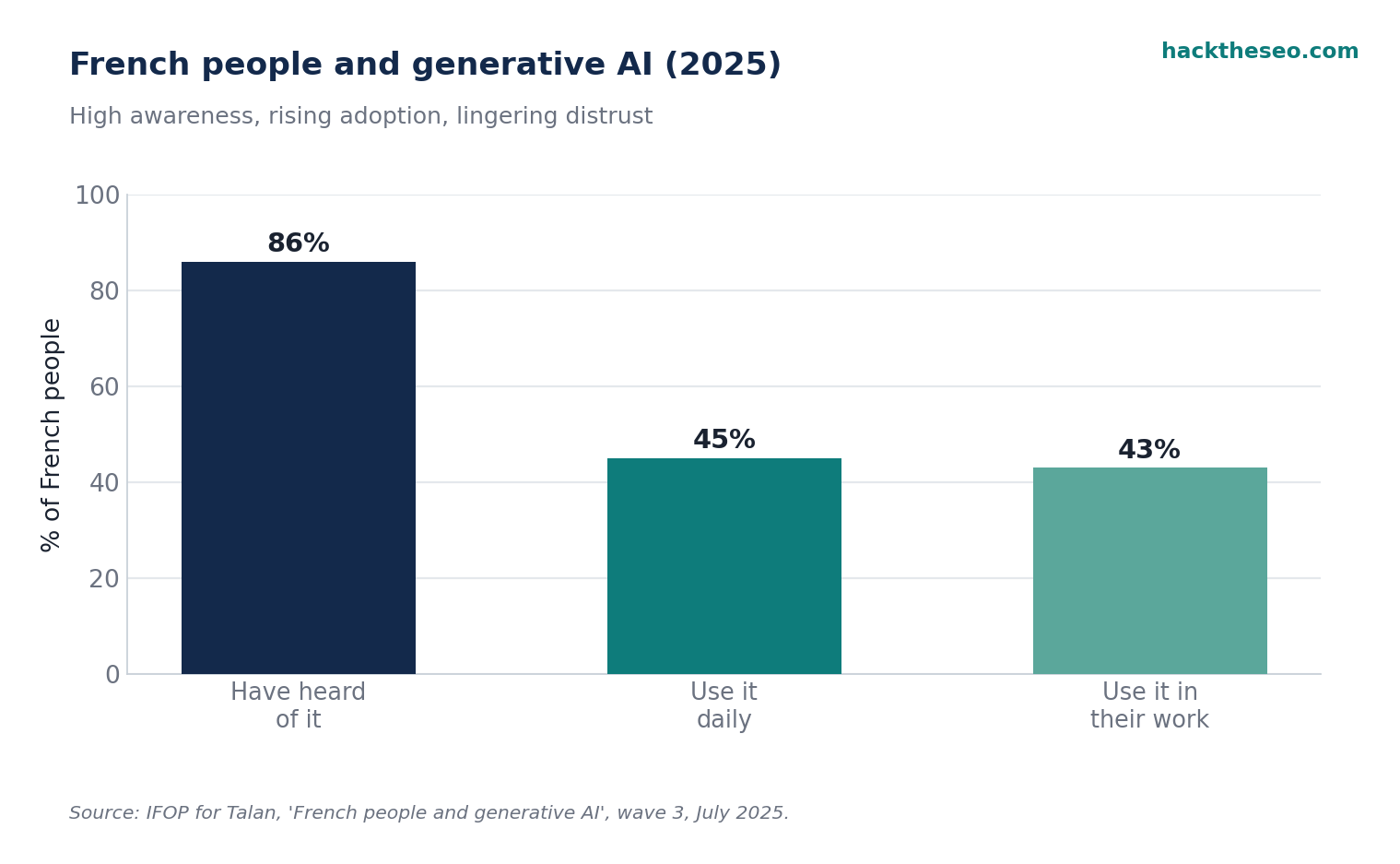
And the audience is ready. According to the IFOP-Talan 2025 barometer, 86% of French people have heard of generative AI, 45% use it daily and 43% use it at work.
EMy takeHere’s how we approach GEO at Hack The SEO, and what you can copy. One: we structure every piece of content into clear, quotable answers (one question, a sharp three-line answer, then the detail). AIs love it. Two: we generate an llms.txt file to tell the models what to read first on the site. Three: we track GPTBot, ClaudeBot and PerplexityBot to know whether the AI crawlers actually come, and where. Four: we score every page with a GEO Score, on the criteria AIs use to pick their sources.
And the simplest reflex, to do tonight: type your key queries into ChatGPT, Gemini and Le Chat, and check whether you’re cited. If you’re not there, you know where the work is. GEO today looks like SEO in 2010: whoever starts early builds a lead that’s hard to catch.
6. What still works: content, E-E-A-T, links
Good news, most of the fundamentals still hold. Some even get stronger.
Human content keeps the edge. Even though 74% of new web content now contains AI, roughly 80% of #1 positions are still held by human-written content, and pure AI content caps out at 17% of the top 20 (Semrush, Originality.ai, 2025-2026). Freshness pays too: content cited by AI is on average 25.7% more recent than classic ranking pages. Publishing isn’t enough anymore, you have to maintain.
Click-through rate by position is still a useful compass, keeping in mind it drops with AI Overviews:
| Position | CTR (Backlinko, 2019) | CTR (FirstPageSage, 2025) |
|---|---|---|
| 1 | 27.6% | 39.8% |
| 2 | 15.9% | 18.7% |
| 3 | 11.0% | 10.2% |
| 4 | 8.0% | 7.2% |
| 5 | 6.1% | 5.1% |
| 10 | 2.7% | 1.6% |
Links still count. 66% of pages have no backlink at all, and the #1 result has on average 3.8 times more than its runners-up (Ahrefs, Backlinko). As for E-E-A-T (experience, expertise, authoritativeness, trust), it’s not a magic setting, but lived experience and a real author signature carry weight. That’s exactly what an AI can’t fake.
A word on the French playing field. Our content plays a slightly different game than English: less volume, often less competition on the long tail, and models like Mistral trained partly on our sources. That’s an opportunity. On the sites we support, the single biggest lever is still the semantic silo (a pillar article surrounded by its satellites, tied together by clean internal linking). We’ve measured up to 2x traffic from a single well-built silo, in under a month. It’s not magic, it’s structure.
7. Local, e-commerce, social: the French angles you can’t miss
Local SEO is still one of the most profitable grounds, especially for a small business. 46% of Google searches have local intent, and reviews carry weight: 97% of consumers read them, and they account for roughly 20% of the ranking in Google’s local pack (BrightLocal, Whitespark, 2025-2026).
French e-commerce is a giant: €175.3 billion in 2024 (+9.6%), and the €200 billion mark could fall as soon as 2026 (FEVAD, 2025). One number deserves your attention if you sell online: marketplaces already account for 31% of product sales. That mirrors what we see in the US, where 50% of product searches start on Amazon, versus 31.5% on Google. Your product SEO isn’t only played on Google, it’s played on Amazon too. That’s exactly why we built a dedicated WooCommerce module: optimizing product pages and linking them together really moves the needle.
Social search is rising, especially among younger users: 49% of US consumers have already used TikTok as a search engine in 2026. The trend exists in France too, even if the “TikTok over Google” hype has cooled a bit.
EMy takeFor a French online retailer, the lesson fits in one sentence: don’t put all your eggs in the Google basket. A third of your potential sales plays out on marketplaces, a growing share of product discovery runs through TikTok, YouTube and AI. SEO in 2026 is a multi-front visibility strategy: Google, Amazon, social networks and AI engines. The right move isn’t to do everything everywhere, it’s to know where your customers really are and be better than your competitors there.
8. The SEO market: it’s changing, but it’s growing
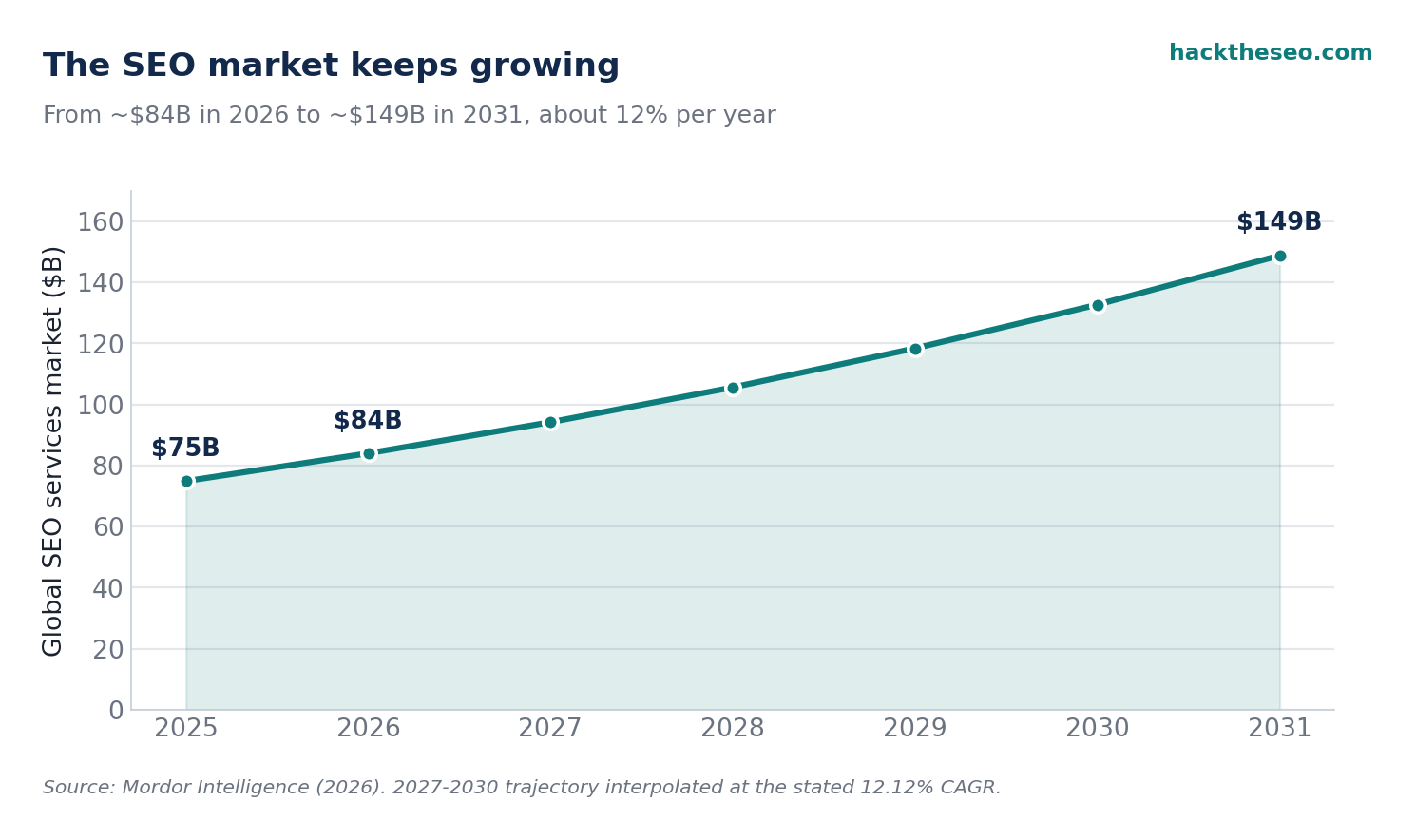
Despite the damage, or maybe because of it, the SEO market is doing well. SEO services are worth about $84 billion worldwide in 2026, with a projection to $149 billion by 2031, roughly 12% growth a year (Mordor Intelligence, 2026).
On pay, an SEO specialist earns on average $86,000/year in the US. In France, an SEO consultant usually sits between €30,000 junior and €70,000 senior, before the high-day-rate freelancers (Glassdoor, FR salary references, 2025-2026). And the return on investment is still there: the best programs post triple-digit results, with a break-even point around 6 to 12 months. Let’s be honest for a second: be wary of anyone promising first position in a week. Count on 60 to 90 days for solid results. SEO rewards consistency, not flashy moves.
EMy takeThe job isn’t disappearing, it’s being reshaped. The skills that will gain value: GEO, data (knowing how to measure what doesn’t show up in a clicks report), information architecture, and the ability to produce genuinely expert content. Our bet at Hack The SEO is that a small business doesn’t need to hire a team for this: it needs tools that execute, not tools that just flag problems. But whether you go through a tool, an agency or your own hands, the principle is the same: become the source AI wants to cite.
9. My conclusion: 7 priorities for 2026
If I had to sum up what I’d put in place this week on a French site, here are my seven priorities.
- Shift from ranking to citation. Optimize to be picked up by AI Overviews and LLMs, not just to sit on page one.
- Invest in the brand. It’s your best insurance against zero-click: a searched-for brand keeps its clicks.
- Structure for AI. Clear, quotable answers, structured data, an llms.txt file, concise formats at the top of the article.
- Get out of Google. Reddit, YouTube, LinkedIn, Wikipedia, Amazon, TikTok, and Mistral’s Le Chat for the French audience.
- Bet on human and fresh. Expert content, lived experience, regular updates, solid semantic silos.
- Change your dashboard. Impressions, branded searches, AI bot visits, citations in answers. Not clicks alone.
- Act this week. AI Overviews are already here. Audit your most exposed pages and secure the ones that sell.
SEO isn’t dead. It’s becoming the most strategic role in marketing, the one that decides whether your brand exists, or not, in AI’s answers. But your stake hasn’t changed. It’s not SEO, it’s your revenue.
Turn these numbers into traffic
Hack The SEO is the SEO + GEO plugin that executes for you, right inside WordPress: living semantic silos, automated internal linking, GEO Score, llms.txt and AI-bot tracking (GPTBot, ClaudeBot, PerplexityBot). Built for small businesses, made in France.
FAQ
Do AI Overviews spell the end of SEO in France?
No, but the end of SEO measured in clicks alone. Search volume keeps growing, Google stays around 89% in France, and a growing share of answers is consumed right on the results page. SEO is shifting toward visibility in AI answers (GEO), brand strength and conversion.
How much traffic drop should a French site expect?
Based on US, UK and German data, plan for 20% to 40% lower CTR on your informational pages within 6 to 12 months. Your transactional and brand pages will be far less affected.
Will ChatGPT overtake Google?
Not in the short term. Google gets about 210 times more queries than ChatGPT. But AI search is growing fast and becoming a visibility channel in its own right, alongside Google, not instead of it.
Can AI-generated content rank?
Yes, 74% of new content contains AI. But roughly 80% of #1 positions stay human. AI helps you produce; expertise, lived experience and freshness make the difference.
Where do I actually start?
Three actions this week: audit your 20 most-visited pages to spot the ones answering questions (the most exposed), test your key queries in ChatGPT, Gemini and Le Chat to see whether you’re cited, and start tracking your impressions and branded searches, not just your clicks.
Sources
AI, AI Overviews & zero-click
- Pew Research Center · Clicks and AI summaries (2025)
- Ahrefs · AI Overviews reduce clicks · Citations & top 10
- Semrush · AI Overviews Study · Seer Interactive · AIO impact on CTR
- Amsive · AI Overviews & click drop-off · SparkToro · Zero-click 2026
- Bain & Company · AI search · Similarweb · AI referral traffic · TechCrunch · AI Overviews 2B / AI Mode
French market
- Google / Blog du Modérateur · AI Overviews & AI Mode rollout in France (July 22, 2026)
- Google · AI Overviews and AI Mode launch (official FR blog)
- StatCounter · Search engine market share, France · FEVAD · France e-commerce report 2024
- IFOP for Talan · Barometer “French people and generative AI” 2025 · franceinfo · Mistral Le Chat, 1 million downloads
Search, content, links & market
- StatCounter · Worldwide market share · SparkToro · Google’s 2024 growth
- Ahrefs · 96.55% of pages get no traffic · Backlinko · CTR stats · FirstPageSage · CTR by position
- Originality.ai · AI content in search results · Mordor Intelligence · Global SEO market · PowerReviews · Product search, Amazon vs Google
About. Written by Eric Ibanez, co-founder of Hack The SEO (hacktheseo.com) with Bruno, co-authors of an SEO book published by Dunod, based in Montpellier, France. We build an SEO and GEO plugin for WordPress, made for small businesses, used on more than 1,300 sites. Data compiled from more than 40 primary sources (US, worldwide and France), verified and dated in July 2026. Figures move fast, check the dates before quoting. Reproduction allowed with a link to the source.