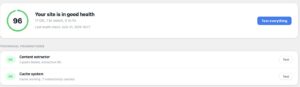
The top AI SEO tools in 2026 each automate one part of SEO: Semrush and Frase speed up research, Surfer SEO helps you write, Search Atlas pushes on-page changes, and WordPress plugins like Rank Math, Yoast SEO and Hack The SEO work inside your site. No tool does all of SEO alone: pick it from the job you want off your plate, and from who approves the changes.
This guide sorts the tools by job, not by hype, and shows what AI assistants actually recommend: we measured 523 answers from ChatGPT, Claude, Gemini, Google AI Overviews and AI Mode on our own site.

Is there an AI that can do SEO?
Yes, an AI can do a large part of the daily SEO work in 2026: keyword research, briefs, first drafts, titles, meta descriptions, internal links and many technical fixes. What it cannot do well on its own is choose the strategy, prove facts about your business, earn links from other sites or take responsibility for a change that hurts traffic.
So the useful question is not “can AI do SEO?” but “which tasks do I hand over, and who checks the result?”. Google says it plainly in its guidance on AI-generated content: using AI is fine, but content made mainly to manipulate rankings breaks its spam policies on scaled content. A tool that writes 50 articles a month with nobody reading them is a risk. A tool that proposes an action, shows you the before and after, and lets you undo it is a different story.
Top AI SEO tools at a glance
Seven tools cover most needs in 2026: four web apps for research and writing, and three WordPress plugins that act inside your site. The table sorts them by the job they do best and by where they work.
| Tool | Type | Best at | Works inside WordPress? |
|---|---|---|---|
| Semrush | Web app (suite) | Keyword research, site audit, rank tracking | No, you apply the fixes |
| Frase | Web app | Briefs and outlines from the top results | No |
| Surfer SEO | Web app | Writing and scoring content against the top results | No |
| Search Atlas | Web app | Automated on-page changes (OTTO) | Through a script added to your site |
| Rank Math | WordPress plugin | On-page settings, schema; AI writing as a paid add-on | Yes |
| Yoast SEO | WordPress plugin | On-page checks; AI titles and meta descriptions in Premium | Yes |
| Hack The SEO | WordPress plugin | Finds topics, writes articles, links pages, fixes what blocks; you approve each action | Yes |
How we chose these AI SEO tools
We kept the tools that come back in Google’s top results for this topic on 28 October 2026 or in the AI answers we measure, and that automate at least one SEO job with AI. We read the pages that rank first for “top ai seo tools” and the related questions Google shows, then sorted every tool with three questions: which job does it automate, where does it act (a web app or inside WordPress), and who approves the change before it goes live.
We give no prices for third-party tools: plans, credits and add-ons change too often, so check each vendor’s pricing page on the day you buy. Hack The SEO is our own product; we say so each time it appears, and we publish our own low AI visibility score below rather than hide it.
The 7 AI SEO tools, one by one
Each tool below is described by what it automates, what you still do by hand, and who it suits best. Read them with your own site in mind: the right tool is the one that removes your slowest task.
1. Semrush: research and audits
Semrush is a large SEO suite: keyword research, competitor analysis, site audit and rank tracking, with AI features added on top. It tells you what to fix and what to write, but you make the changes in WordPress yourself. It suits marketers who want one dashboard for many sites and are happy to apply the recommendations by hand.
2. Frase: briefs in minutes
Frase reads the pages that rank for a keyword and turns them into an outline: headings, questions people ask, topics to cover. It saves the research hour before each article. The draft still needs your own facts, or it will only repeat what already ranks. Good for writers who publish often and want a fast, consistent starting point.
3. Surfer SEO: writing against the top results
Surfer SEO scores your text while you write, by comparing it with the pages in the top results: missing terms, length, headings. It also offers AI writing. The score helps, but a high score is not a ranking: a page wins when it adds something the others don’t have. Good for content teams who want a shared quality bar.
4. Search Atlas: automated on-page changes
Search Atlas goes further than advice: its OTTO assistant applies on-page changes, such as titles and tags, through a script added to your site. That is fast, but the changes live in the script: check what remains in your pages if you stop the subscription. Suits agencies that manage many sites and want speed.
5. Rank Math: the WordPress settings, with an AI add-on
Rank Math is one of the most installed SEO plugins for WordPress: titles, meta descriptions, schema, redirections and a content score per page. Its AI writing (Content AI) is a paid add-on with credits. It does what you set up, page by page; it does not choose topics or link your pages for you.
6. Yoast SEO: the classic on-page checks
Yoast SEO checks each page while you edit it: keyphrase, readability, meta description. Yoast SEO Premium adds AI-generated titles and meta descriptions. Like Rank Math, it is a very good base for on-page settings, but the strategy, the articles and the internal links stay your job.
7. Hack The SEO: SEO and GEO actions inside WordPress
Hack The SEO is our plugin. It finds the topics that bring traffic, writes the articles, links pages together and fixes what blocks, for Google and for AI answers (GEO). Each action is proposed with its before and after; you approve it, and you can undo it for 30 days. It works on WordPress only.
Which AI SEO tool for which job?
Pick the tool from the job you want to stop doing by hand: most sites need two at most, one for research or writing and one that acts on the site.
- Finding what to write: Semrush or Frase. Free data from Google Search Console shows the queries you already appear for.
- Writing and improving a page: Surfer SEO. Always add your own facts: a draft that only repeats the top 3 has no reason to rank above them.
- Fixing on-page issues at scale: Search Atlas through a script, or a WordPress plugin that writes the change in the page itself, so it stays if you stop the tool.
- Linking pages together: the most forgotten job. A plugin that sees all your pages can propose links with varied anchors; a web app usually only lists the gaps.
- Getting cited by AI assistants: clear answers at the top of each section, tables, sourced numbers. Our guide on the 12 criteria that get a page cited in AI Overviews goes through them one by one.
Which AI SEO tool for your profile?
A freelancer, a small business and an agency do not need the same tool: the more sites you run and the less time you have, the more the tool should act for you, with your approval.
| Your profile | What you need most | Tools to look at |
|---|---|---|
| Freelancer, a few client sites | Save hours on research and writing | Frase or Surfer SEO, plus Rank Math or Yoast SEO for the settings |
| Small business on WordPress, no SEO team | Someone or something that does the work and asks before publishing | A WordPress plugin that proposes actions you approve, such as Hack The SEO; Yoast SEO or Rank Math for the basics |
| Agency, many sites | Research, reports and fixes at scale | Semrush for research and audits, Search Atlas for scripted fixes |
| Content team | A shared quality bar for every writer | Surfer SEO or Frase |
What do AI assistants recommend when asked about SEO tools?
When people ask AI assistants about WordPress SEO tools, the same few names come back: in 523 answers measured over 7 days, Yoast was cited in 75.9% of them and Rank Math in 75.3%. We run this measure on hacktheseo.com every night, on ChatGPT, Claude, Gemini, Google AI Overviews and Google AI Mode (7 days to 27 October 2026).
| Brand | Share of answers that cite it |
|---|---|
| Yoast | 75.9% |
| Rank Math | 75.3% |
| Google Search Console | 53.2% |
| SEOPress | 47.6% |
| Semrush | 40.2% |
| AIOSEO | 38.2% |
| Hack The SEO | 2.9% |
Two lessons. First, AI assistants favour brands that many pages already describe: being old and widely reviewed matters more than being new. Second, our own score is low (2.9%, 51st of 145 brands), and we publish it anyway: it is the number we work on. If you choose a tool because “ChatGPT recommended it”, remember the answer reflects what the web says most often, not a test of the tool.

What can’t AI SEO tools do yet?
AI SEO tools still can’t decide your strategy, know facts about your business they were never given, or earn links from other websites for you. They also make confident mistakes: a wrong price, an invented statistic, a page linked to itself.
On our site, AI crawlers visited pages far more often than search engines: 8,767 visits from AI robots in 28 days (30 August to 26 September 2026) against 3,939 from Google, Bing and the other engines. Robots read a lot; that does not mean they cite you. Citations come from pages that answer clearly, with numbers a reader can check. No tool can promise a position on Google or a mention in ChatGPT, and you should be wary of any tool that does.
“The AI does the repetitive work very well. The strategy, the facts and the final yes stay with a human”, sums up Eric Ibanez, co-founder of Hack The SEO and co-author of the book Le SEO pour booster sa croissance (Dunod, 2025).
How to choose an AI SEO tool for a WordPress site
For a WordPress site, check five things before you pay: where the tool acts, who approves, how you undo, which data it uses and what it really costs per month.
- Where it acts: in a web app you copy and paste from, or inside WordPress.
- Who approves: can you see the before and after of each change before it goes live?
- How you undo: one click, with a log of every change, or by hand.
- Which data: your own Search Console queries, or only generic keyword lists.
- The real monthly cost: plan, add-ons and credits, without commitment if possible.
If you also want to automate audits, our step-by-step guide shows how to run a WordPress SEO audit with Claude (MCP), and our comparison of 12 SEO automation tools with prices and setup goes deeper on workflow tools.
Where does Hack The SEO fit?
Hack The SEO is a WordPress plugin that does SEO and GEO (visibility in AI answers) inside your site: it finds the topics that bring traffic, writes the articles, links pages together and fixes what blocks. You approve each action, and every action can be undone for 30 days, with a full log.
It costs 249 € excl. VAT per month, without commitment, and it is sold after a 20-minute video demo. It works on WordPress only. If that is your setup, see how our AI WordPress SEO plugin works, or talk to an expert to see it on your own site.
Questions people also ask about AI SEO tools
Three questions come back in Google’s results for this topic: whether free tools are enough, whether AI content gets penalised, and whether SEO will last. Short answers below.
Are free AI SEO tools enough?
For a small site, free tools cover the basics: Google Search Console for your real queries, a free plugin for titles and meta descriptions. They stop being enough when you need content at a steady pace, internal links across hundreds of pages, or a record of every change.
Can AI-written content get my site penalised?
Google does not penalise content because an AI wrote it; it targets content made at scale without value for the reader. Add your own facts, data and examples, and have a human read before publishing.
Will SEO still exist in 5 years?
Search is changing, not disappearing: AI assistants and AI Overviews still pick their sources from pages they can read and trust. The work shifts from ranking in ten blue links to being the page an AI quotes.