The essentials in 6 points:
- An llms.txt file is a map of your site for AI: a Markdown file at
yoursite.com/llms.txtthat points to your important pages. - It is not an official standard. It is a proposal from Answer.AI (September 2024), neither ratified by the W3C nor adopted by Google.
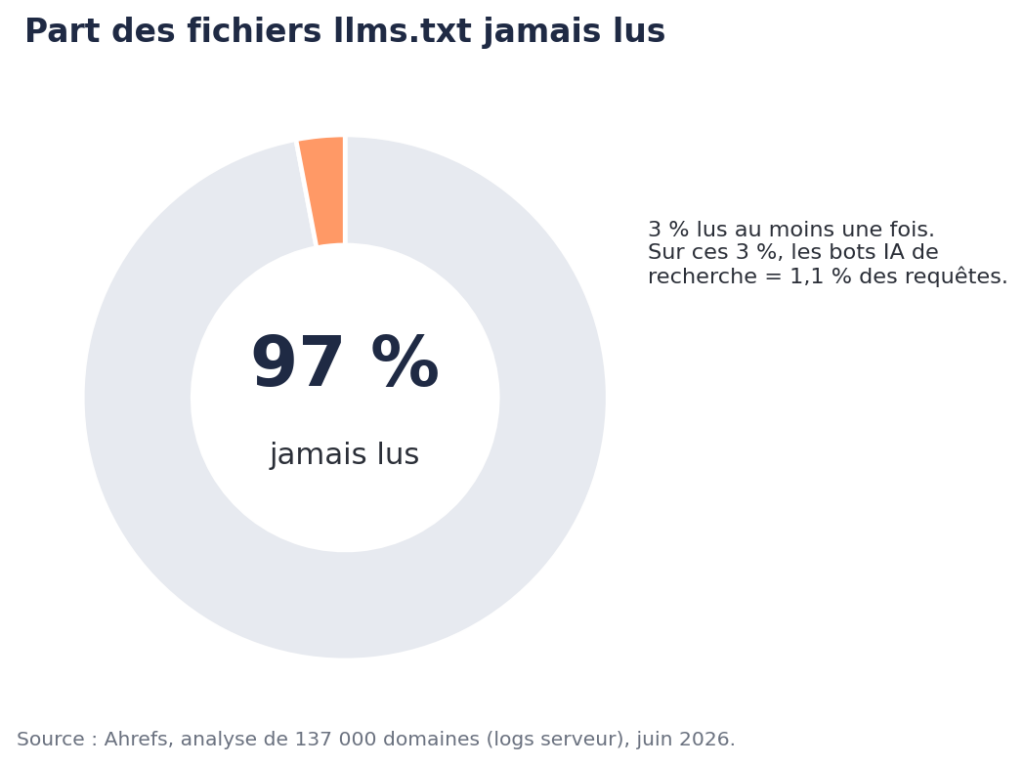
- The key figure: 97% of llms.txt files are never read (Ahrefs, 137,000 sites, June 2026). No correlation with AI citations has been proven (SE Ranking, 300,000 domains).
- Google states plainly that it does not use it. John Mueller compares it to the old “meta keywords” tag.
- Its real value is on the coding-agent side (Claude Code, GPTBot) and technical documentation. And as a low-cost bet for the future.
- On WordPress, setup takes two minutes. The real work is not creating the file, it is measuring whether AI bots come to read it.
What is an llms.txt file?
An llms.txt file is a Markdown text file, placed at the root of a site (yoursite.com/llms.txt), that tells AI models which pages to read first and how to understand your content. It is the equivalent of a robots.txt, but designed for large language models rather than search engines.
The idea comes from Jeremy Howard, co-founder of Answer.AI, who proposed it on September 3, 2024 (source: Answer.AI). The problem he set out to solve is simple. An AI’s context window is too small to swallow an entire site, and turning HTML (ads, menus, JavaScript) into clean text gives an approximate result. The site owner knows better than anyone which pages matter, and the llms.txt is that curated list.
Do not confuse it with robots.txt. The llms.txt blocks nothing and controls no access. It only suggests.
llms.txt vs llms-full.txt: the difference
There are two files, and they often get mixed up.
| File | Content | For whom |
|---|---|---|
/llms.txt |
An index: a summary plus links to your key pages. Lightweight, a map of the site. | Most sites. The standard format (92.7% of existing files). |
/llms-full.txt |
The full text of your important content, flattened into a single Markdown file. Heavy. | Small sites, technical documentation, APIs that fit inside a context window. |
Source for the shares: Originality.ai, May 2026.
In other words, the llms.txt says “here is where to look,” while the llms-full.txt says “here is everything, already chewed.” On a WordPress site with hundreds of articles, an llms-full.txt quickly becomes a wall of several hundred thousand words. Vercel’s weighs the equivalent of a 400,000-word novel, impossible to maintain by hand.
Does llms.txt actually do anything? (our take)
For your visibility in AI search, the answer is no. Not in 2026, not with the evidence we have today. It is worth saying up front, because a lot of articles on the subject carefully skip the point.
One useful note before the numbers: we publish a WordPress SEO and GEO plugin used on more than 1,300 sites, and we track AI bot visits on those sites in real time. What we see in the field lines up with the studies.
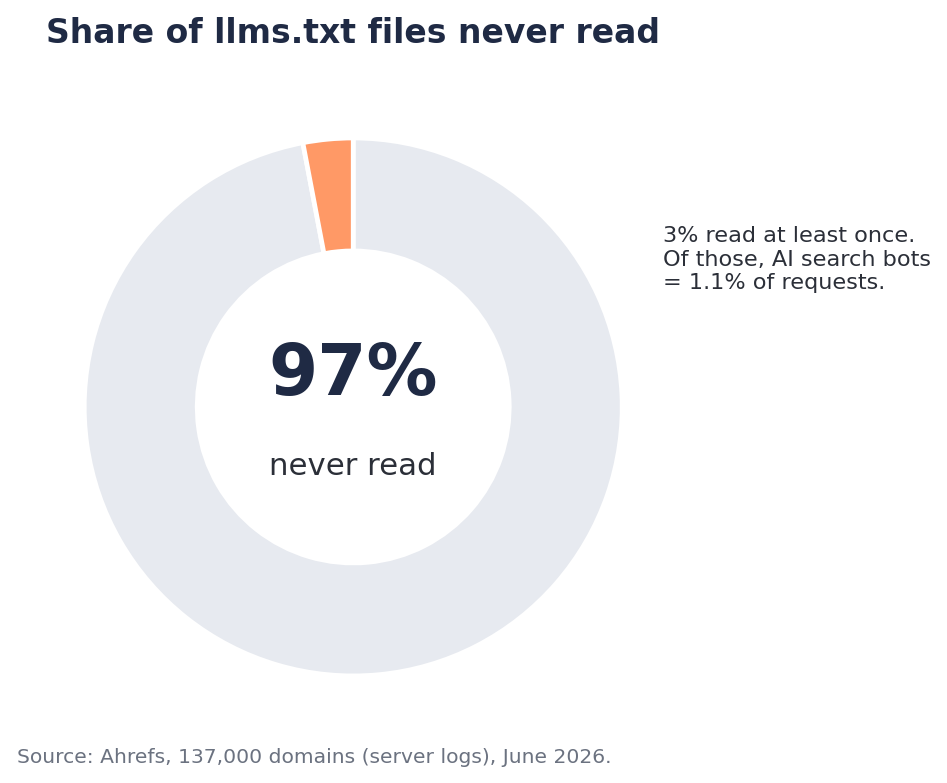
Across 137,000 sites analyzed, almost none of the llms.txt files ever receive a single request.
Two independent, large-scale studies reach the same conclusion.
- Ahrefs analyzed the server logs of 137,000 domains in May 2026: 97% of llms.txt files received no request at all. Of the 3% that are read, 77% of the visits come from bots that are not even AI (SEO audit tools, generic crawlers). AI search bots account for 1.1% of requests (source: Ahrefs, June 2026).
- SE Ranking cross-referenced 300,000 domains: no correlation between the presence of an llms.txt and how often the site is cited by AI. More telling, when the researchers remove the “llms.txt” variable from their model, its accuracy improves. The file adds more noise than signal (source: SE Ranking, November 2025).
On Google’s side, it is even clearer. John Mueller compared the llms.txt to the “meta keywords” tag, the old signal everyone eventually abandoned because it was declarative and unverifiable. In June 2025, he added that no AI system currently uses llms.txt (source: Search Engine Journal, April 2025). In its documentation on AI search, updated in mid-2026, Google repeats it in a myth-busting section: you do not need to create special text files or Markdown to appear in Search, because Google does not use them.
Our take. We integrated llms.txt into our plugin, and the GEO Score feature even generates and serves one automatically. And yet we advise against expecting a miracle from it. Credibility is what gets a source cited. A file that 97% of the web never has read is hygiene, not visibility. The day that changes, we will be among the first to see it, because we measure AI bot visits instead of assuming them. More on that below.
Why bother with it in 2026?
If llms.txt does not rank, why are so many sites adopting it? Because adoption is climbing fast, and there are three real reasons to do it, as long as you do it for the right ones.
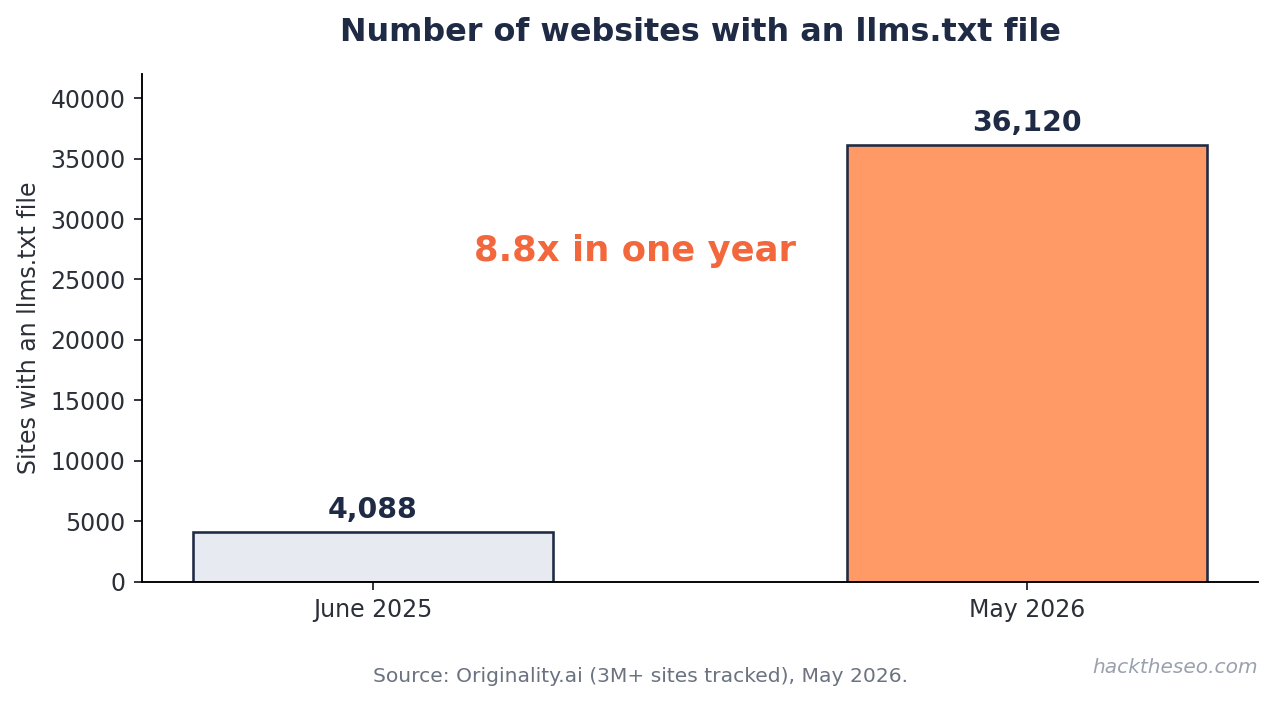
The number of sites with an llms.txt has grown 8.8x in one year. Actual usage, however, stays marginal, but the wave is real.
First, coding agents do read it. This is the one solid signal in the Ahrefs logs: Claude Code, Anthropic’s development agent, is the second-largest consumer of llms.txt, ahead of every search bot, with GPTBot in first place. If you publish documentation, an API, a SaaS, or if your customers use AI agents to work, the file has concrete value.
Second, it is a low-cost bet on the future. Two minutes to set up, no risk, and the day an engine decides to use it, you are already ready. Not everyone agrees on burying it, either. Carolyn Shelby, from Search Engine Land, points out that, unlike meta keywords, the llms.txt points to real, verifiable URLs: it is not a wish list, it is a spotlight on actual content.
Third, no major provider has committed either way. OpenAI, Anthropic, Google, Perplexity, and European models like Mistral all publish an llms.txt for their own documentation, yet none recommends relying on it for visibility. Preparing for that ground is not unreasonable, as long as you keep your expectations honest.
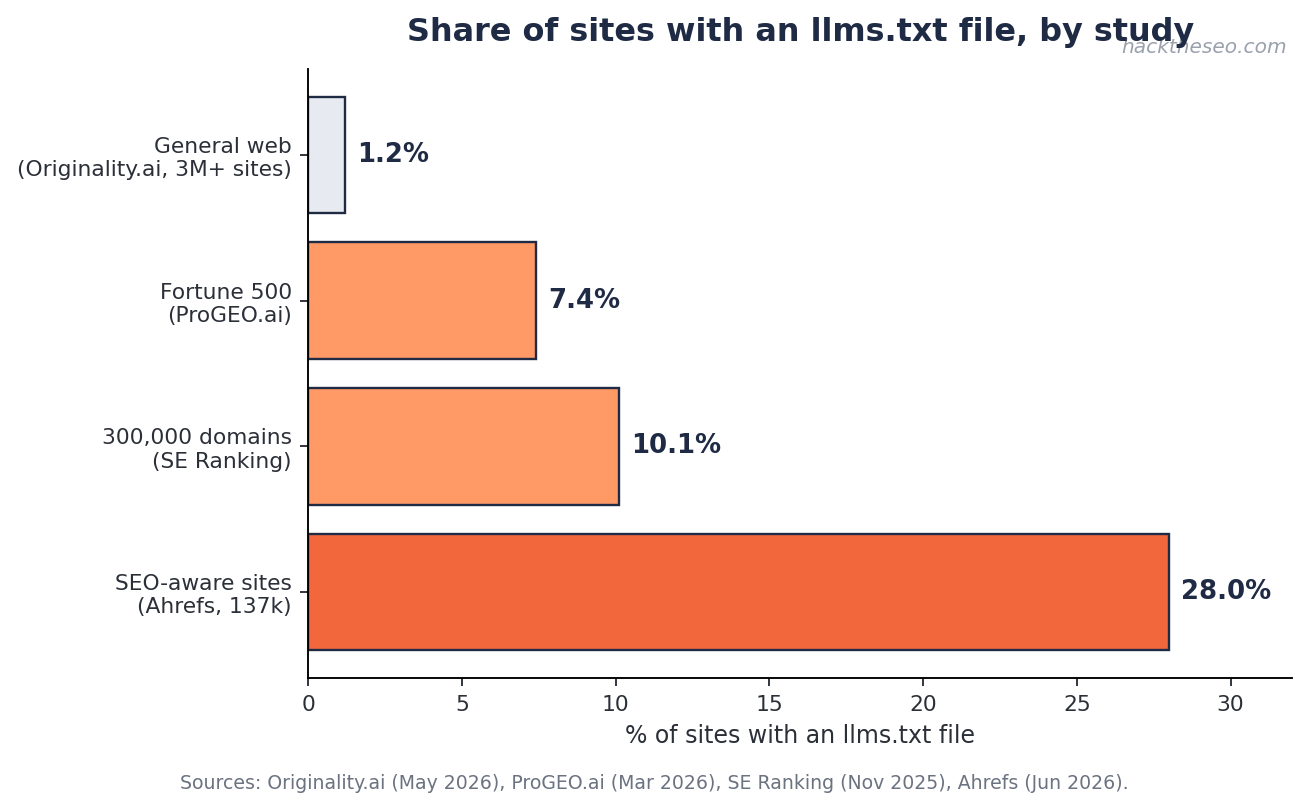
Depending on whether you measure the general web or sites that are already SEO-savvy, the adoption rate runs from 1 to 28%. It is still a niche practice.
How to create and set up an llms.txt on WordPress?
On WordPress, you have two paths: the plugin (recommended, automatic) or the manual method. Here are both, with their traps.
1. The plugin method (two minutes, recommended)
This is the simple route, and above all the most durable, because the file regenerates on its own every time you publish.
- Install a plugin that handles llms.txt (see the comparison below). Yoast, Rank Math, and AIOSEO do it for free.
- Enable the option (often under “Settings,” “Technical SEO,” or “Sitemaps”).
- Choose which content types to include (posts, pages, products) and the URL limit.
- Save. The file is served at
yoursite.com/llms.txt.
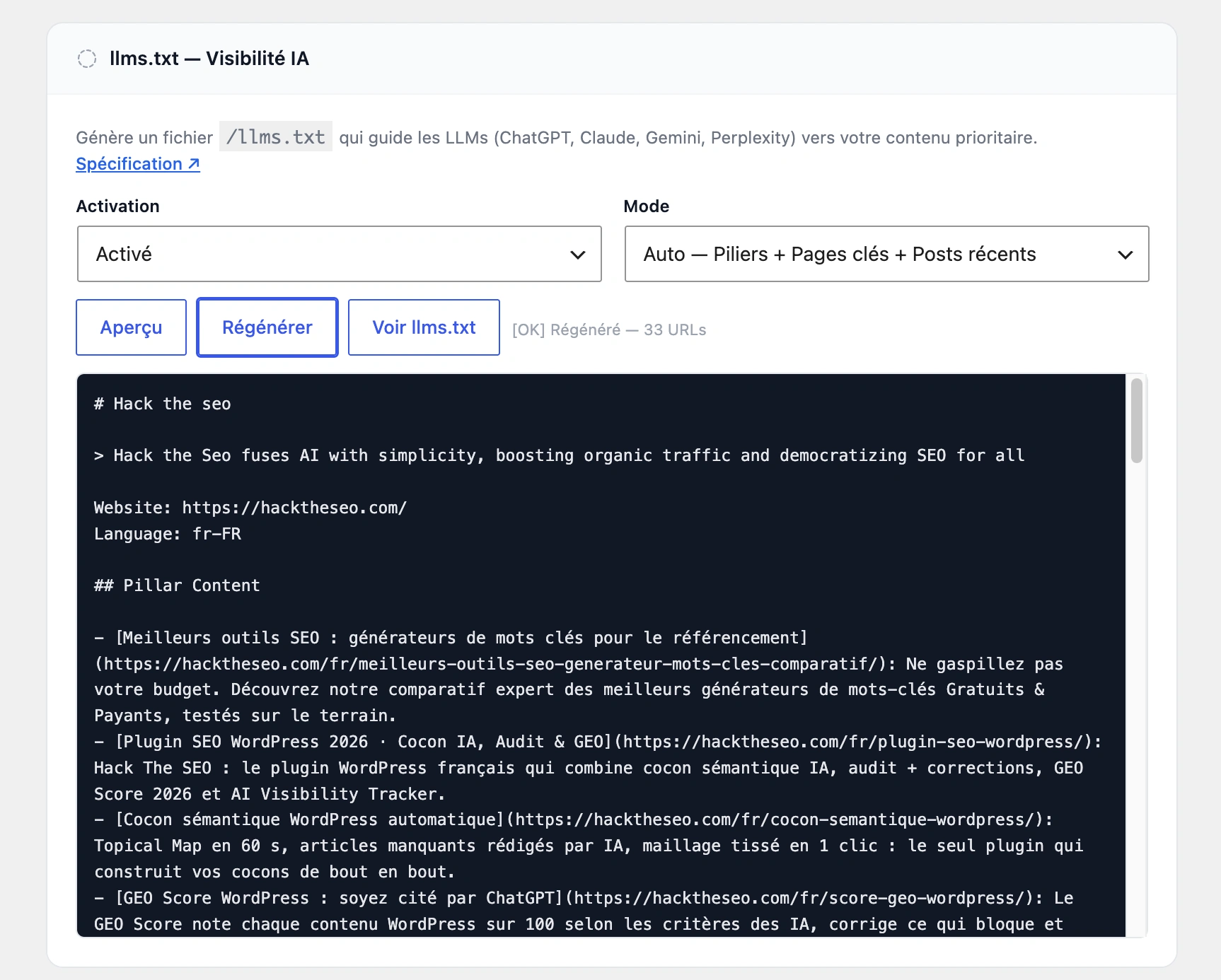
Enabling and generating the llms.txt inside the Hack The SEO plugin.
At this point, you should be able to open yoursite.com/llms.txt in your browser and see your list of pages.
2. The manual method (file plus FTP)
Useful if you want full control, or if your plugin does not handle llms.txt.
- Write your file in Markdown: an H1 title (required), a summary inside a
>blockquote, then##sections with your links formatted as[title](url): description. - Save it as
llms.txt, in UTF-8 without a BOM. - Upload it to the root (
public_html) over FTP or SFTP, not through the WordPress media library.
The WordPress trap few guides mention: a file uploaded through the media library lands in /wp-content/uploads/, not at the root. And on some hosts (WP Engine, Flywheel, WordPress VIP) or subdirectory installs, writing to the root is blocked. In that case you need rewrite rules, or a plugin that serves the file “virtually.” Another trap: the --- separators can be read as YAML front matter and trigger a “missing H1” error in validators.
3. Check that your file is actually served
Open yoursite.com/llms.txt (and /llms-full.txt if you enabled it). You should get a 200 response in text/plain, not a 404 or a redirect. A static file uploaded by hand goes stale the moment you publish a new article. That is the whole point of dynamic plugin generation, which stays fresh automatically.
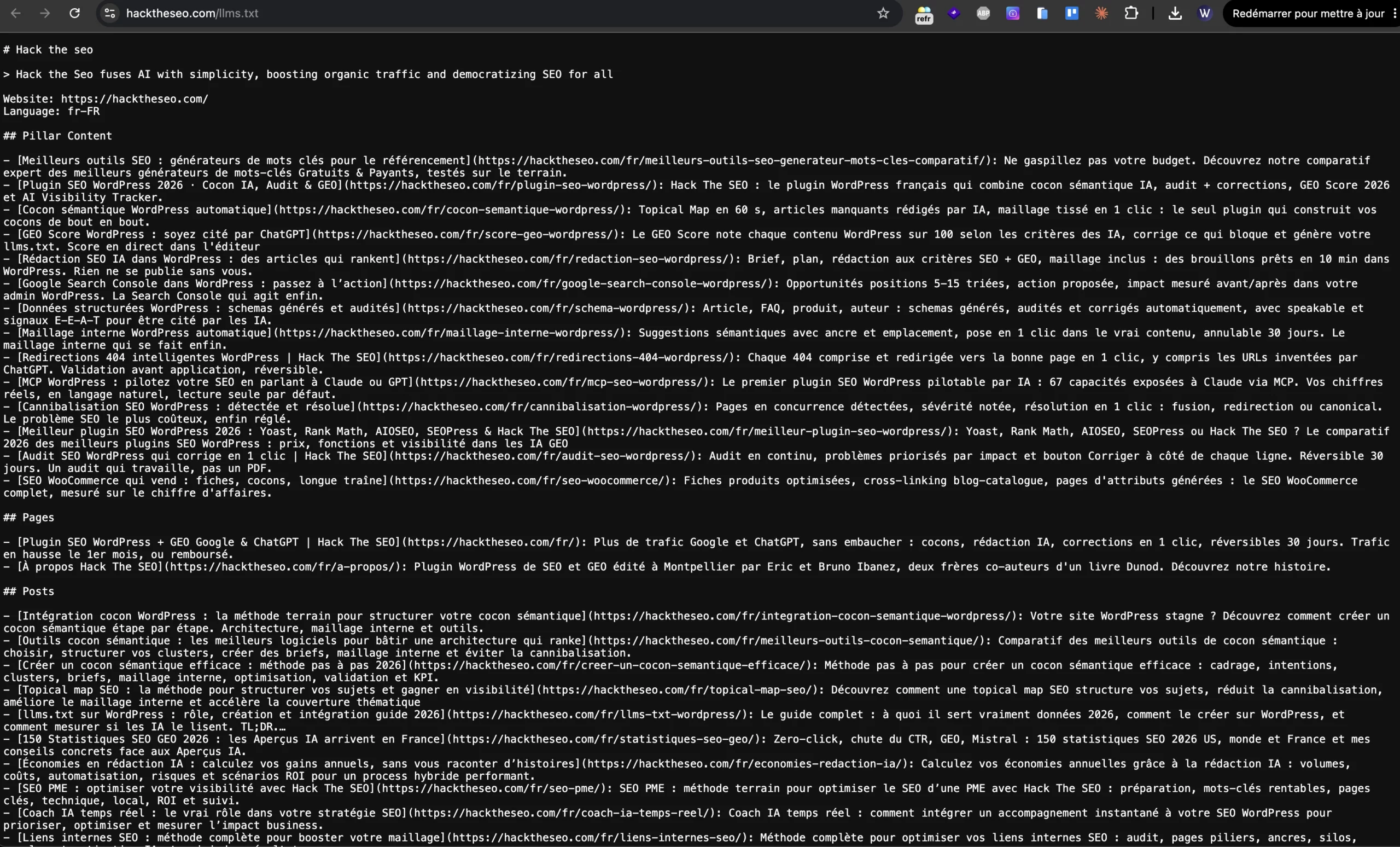
Preview of the generated llms.txt file, served at the site root.
Which WordPress plugin should you choose for your llms.txt?
Most major SEO plugins added llms.txt in 2025 and 2026. Here is the honest comparison, because few articles actually put them side by side.
| Plugin | Free? | Generation | llms-full.txt | Since |
|---|---|---|---|---|
| Hack The SEO | Yes | Dynamic, fresh on publish, with AI bot tracking | Yes | 2025 |
| Yoast SEO | Yes | Physical file, regenerated weekly (5 latest items) | Not documented | June 2025 |
| Rank Math | Yes | Dynamic, choice of content types, excludes noindex | Not documented | July 2025 |
| AIOSEO | Yes | Automatic, with a “convert to Markdown” option | Yes (toggle) | Oct. 2025 |
| SEOPress | Paid (PRO) | Virtual, editable, with placeholders. Integrates Mistral | Not documented | Jan. 2026 |
| Squirrly SEO | Freemium | Generate, edit, upload | Yes | Sept. 2025 |
| Website LLMs.txt (dedicated) | Yes | Automatic (instant, daily, weekly), 40,000+ installs | Yes | 2025 |
Sources: official plugin pages and changelogs (Yoast, Rank Math, AIOSEO, SEOPress, Squirrly, WordPress.org), 2025 and 2026.
The key point: almost all of them do the same thing, generate the file. The real question is not “who generates the llms.txt,” it is “who tells you whether it is doing anything.” And on that front, the list gets short fast.
Our take. Generating an llms.txt is trivial: seven plugins do it, three of them for free. Yoast moved first in June 2025, and that is great. But handing you a file without telling you whether it is read is like selling an alarm without telling you whether it goes off. We made the opposite choice: generate the file, and show you the real visits of GPTBot, ClaudeBot, and PerplexityBot on your site.
How to know if AI bots actually read your llms.txt?
This is the question most guides skip. Creating the file is fine. Knowing whether it changes anything is better. Three ways to measure it.
- Server logs. Look for AI bot user-agents:
GPTBot,OAI-SearchBot(OpenAI),ClaudeBot,Claude-User(Anthropic),PerplexityBot,Google-Extended,CCBot(Common Crawl),Bytespider(TikTok). Filter requests on/llms.txt, and you will quickly see whether anyone reads it. - An “AI referral” segment in GA4. Create a segment on the referrers
chatgpt.com,perplexity.ai,claude.ai, andgemini.google.com. That measures the traffic AI actually sends you, the real KPI. - A tool that does it for you. That is what we built into the Hack The SEO plugin: tracking AI bot visits, page by page, without touching your logs.
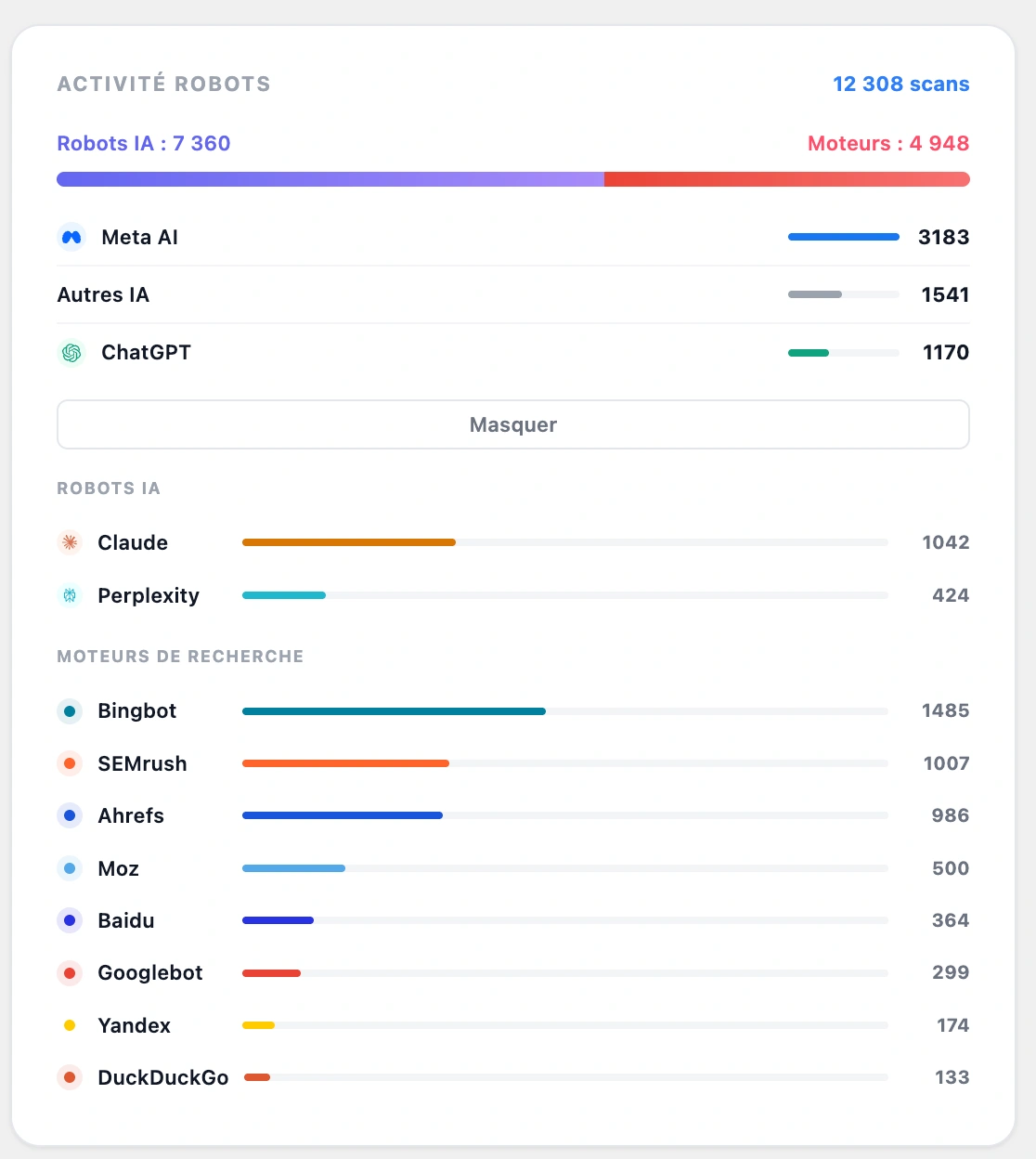
Tracking AI bot visits in the plugin: which bots come, and on which pages.
It is the only way out of guesswork. On the sites we run, we see exactly which bots come, on which pages, and how often. Without that measurement, you are not steering anything, you are assuming. And measuring what does not show up in a click report is precisely what separates SEO in 2026 from the SEO of yesterday.
llms.txt and security: the risk few people mention
One point almost no guide raises. In the Ahrefs logs, one of the biggest llms.txt crawlers identifies itself as prompt-injection-survey. Someone is already studying llms.txt as a prompt-injection attack vector. The logic is simple: it is a file that AI agents are designed to read and trust.
The rule is easy to remember: treat your llms.txt like code. Put only links and descriptions in it, never instructions. Point only to resources you control. Version the file, and review any automatic generation. And of course, do not expose private pages, drafts, or sensitive URLs.
Our verdict on llms.txt in 2026
The llms.txt is hygiene, not growth. Set it up, it costs two minutes and cannot hurt you, as long as you secure it. But do not mistake it for GEO.
To actually get cited by AI in 2026, in Google’s AI Overviews as well as in ChatGPT, the fundamentals are what count: a clear structure (sharp, quotable answers), sourced figures, freshness, standard schema, E-E-A-T, and a strong brand. The llms.txt comes after that, far after.
Do it for agent readiness. Measure the bot visits. And put your energy where it pays off.
Read next
- WordPress SEO plugin: the plugin that generates your llms.txt and tracks AI bots.
- GEO Score for WordPress: measure whether your content is genuinely quotable by AI.
- Structured data on WordPress: the real technical lever for AI Overviews.
- MCP for WordPress SEO: run your SEO by talking to Claude, the agent angle that matters for llms.txt.
- Best WordPress SEO plugin: how the main options compare.
About the author. Eric Ibanez is co-founder of Hack The SEO and co-author of an SEO book published by Dunod. With Bruno, he has been doing SEO for fifteen years and now runs more than 1,300 WordPress sites, with live tracking of GPTBot, ClaudeBot, and PerplexityBot. Published on July 24, 2026, from dated, verified primary sources. Figures change fast, so check the dates before citing.
See AI bots hitting your site: start for free or talk to an expert (20 min).
Sources
- Answer.AI · Original /llms.txt proposal (Sept 3, 2024) · llmstxt.org
- Ahrefs · We Analyzed 137K Sites: 97% of llms.txt Files Never Get Read (June 2026)
- SE Ranking · llms.txt: a study of 300,000 domains (Nov 2025) · covered by Search Engine Journal
- Originality.ai · adoption up 8.8x in 12 months, via PPC Land (July 2, 2026)
- Search Engine Journal · Google (John Mueller) compares llms.txt to meta keywords (April 2025)
- Search Engine Land · No, llms.txt is not the new meta keywords (Carolyn Shelby) (July 2025)
- Yoast · llms.txt generator · Rank Math · llms.txt KB · AIOSEO · llms.txt generator · SEOPress · 9.5 · Squirrly · llms.txt in WordPress
FAQ
- Does llms.txt improve my Google ranking?
- No. Google has confirmed several times, through John Mueller and its documentation, that it does not use llms.txt. For Google Search, including AI Overviews, the SEO fundamentals are what count.
- Do ChatGPT or Perplexity read my llms.txt?
- Very rarely. The Ahrefs study from June 2026 shows that AI search bots account for 1.1% of requests on these files. The only real, measured use is coding agents like Claude Code.
- Do I need an llms.txt or an llms-full.txt?
- The
llms.txt(a link index) is enough for most WordPress sites. Thellms-full.txt(the full content) only makes sense for a small site or documentation, and quickly becomes unmanageable on a large blog. - What is the best free plugin to create an llms.txt on WordPress?
- Yoast, Rank Math, and AIOSEO generate it for free. Hack The SEO generates it too and, on top of that, tracks AI bot visits on your site, which the others do not.
- Is llms.txt an official standard?
- No. It is a proposal from Answer.AI (September 2024), published on llmstxt.org, but it is ratified neither by the W3C nor the IETF, and no major engine has committed to following it.
- Where do I place the llms.txt file on WordPress?
- At the root of the domain (
yoursite.com/llms.txt), not in the media library. A plugin serves it at the right place automatically. Manually, you have to upload it over FTP to the root. - Does llms.txt carry a security risk?
- Yes, a prompt-injection risk: attackers are already testing these files as an attack vector. Put only links to resources you control in it, no instructions, and no sensitive pages.
See AI bots hitting your site
The Hack The SEO plugin generates your llms.txt and tracks GPTBot, ClaudeBot, and PerplexityBot in real time. Stop assuming, start measuring.